


Edition checks | Usage boundaries | Buyer clarity
Zoho AI Pricing: 7 Costly Assumptions to Check Before You Upgrade
Zoho AI pricing starts with one question: are you paying for a missing capability, or overlooking something your existing subscription already includes? An upgrade can be sensible. Buying one before identifying the exact feature, product and usage boundary is where avoidable spending begins.
Imagine a sales manager requesting summaries and a support manager requesting an agent. Both requests sound like “add AI”, yet they can involve different editions, credit systems and bills. This is an illustrative situation, not a Codroid client story.
Quick answer
“Without extra cost” means a verified capability within a purchased plan and its applicable limits. It does not mean a free subscription, unlimited execution, free external-model usage or free implementation. This guide covers selected CRM features, Zia Agents, Analytics, Desk and Zoho One, not every Zoho product.
Official pages checked on 8 November 2026, Asia/Calcutta. Prices below are published subscription or usage rates, not service quotes. Entitlements can change; use the linked evidence alongside your actual organisation settings before approving an upgrade.
Trial access is not a promise that every demonstrated feature remains in your eventual paid edition. Keep the trial decision separate from your production entitlement review.
Zoho AI pricing: seven assumptions that can distort your budget
1. “Included” means the entire service is free
Separate five cost layers: the base app subscription, included functionality, usage allowances or add-ons, optional external-model/API billing, and implementation services. A zero extra feature fee can coexist with the other four. Ask which layer each line of a proposal belongs to.
For a grounded starting point, the CRM comparison displays these INR base rates. They are per user per month, with the stated billing commitment, and local taxes additional. These are not standalone AI prices or negotiated Codroid rates. [1]
| CRM edition | Annual billing basis | Monthly billing basis |
|---|---|---|
| Standard | ₹800/user/month, billed annually | ₹1,300/user/month |
| Professional | ₹1,400/user/month, billed annually | ₹2,100/user/month |
| Enterprise | ₹2,400/user/month, billed annually | ₹3,000/user/month |
| Ultimate | ₹2,600/user/month, billed annually | ₹3,200/user/month |
Do not compare an annually billed monthly equivalent with a monthly commitment as though the payment terms matched. For broader subscription context, use our CRM pricing guide alongside the current official comparison, not as a substitute for it.
2. Every CRM Zia feature requires Enterprise
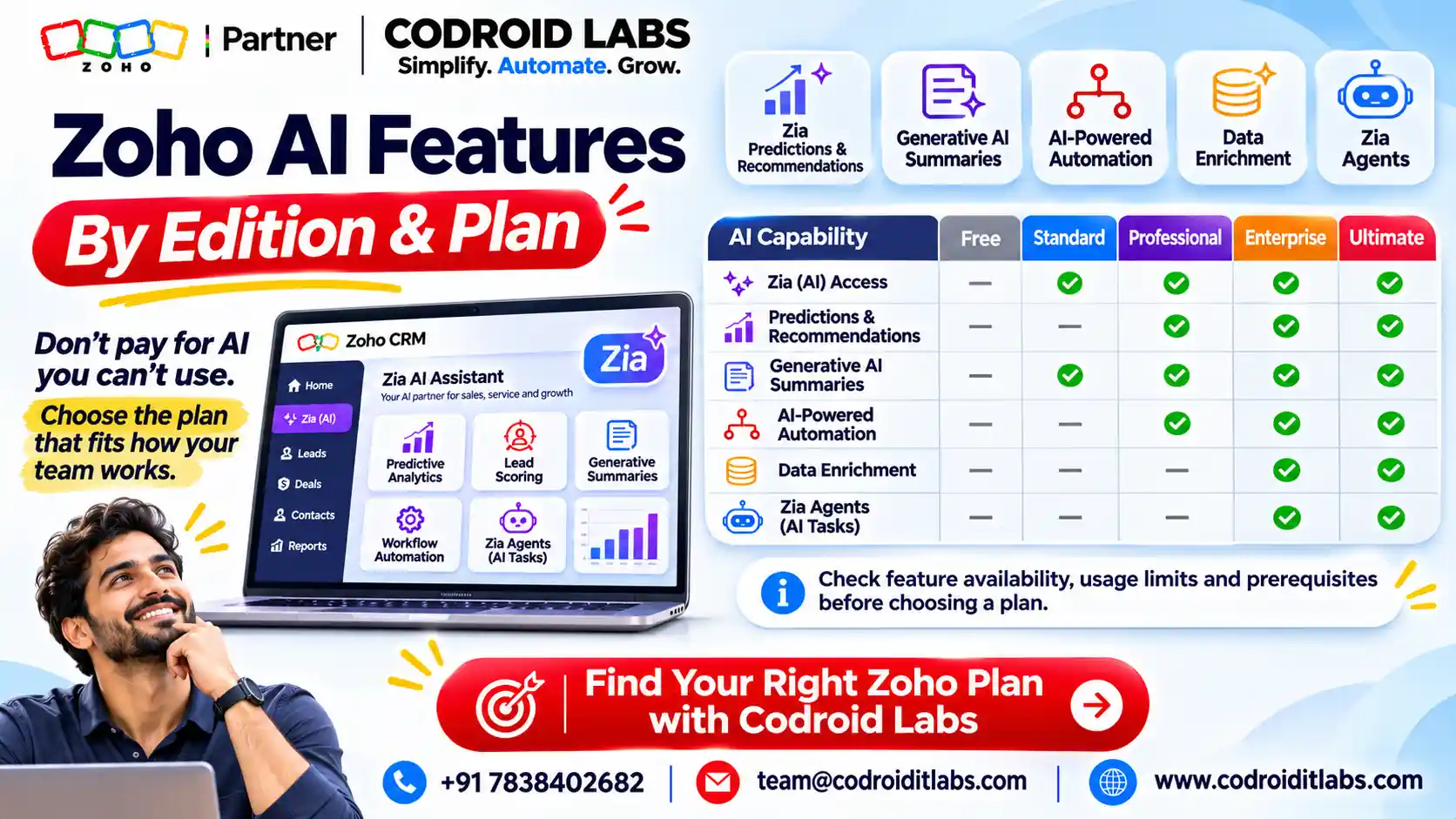
That blanket statement does not match the current feature list. Several selected capabilities appear in Professional, while other features begin at Enterprise or have higher limits in Ultimate. Compare the actual row rather than buying an edition because its name sounds more AI-ready. [1]
Selected CRM Zia features by edition, with exact published limits
The following is a selected matrix, not a complete Zia entitlement catalogue. “Listed” means marked available in the official comparison; “Not listed” means unavailable in that row, not that the entire edition lacks AI. Row quotas are reproduced as displayed, without inventing a reset period. [1]
| Feature | Free | Standard | Professional | Enterprise | Ultimate |
|---|---|---|---|---|---|
| Data Enrichment | Not listed | 500 records/user; max 50,000 | 500 records/user; max 50,000 | 500 records/user; max 50,000 | 2,000 records/user; max 50,000 |
| Field Prediction | Not listed | Not listed | 2/org | 2/org | 20/org |
| Best Time to Contact | Not listed | Not listed | Listed | Listed | Listed |
| Email Intent | Not listed | Not listed | Listed | Listed | Listed |
| Notes Summary | Not listed | Not listed | Listed | Listed | Listed |
| Record Summary | Not listed | Not listed | Listed | Listed | Listed |
| Zia Scores | Not listed | Not listed | 5/org | 5/org | 10/org |
| Best Time to Contact Analytics | Not listed | Not listed | Not listed | Listed; >20 user licences | Listed; >20 user licences |
| Zia Agents | Not listed | Not listed | Listed | Listed | Listed |
Notice the distinction between Best Time to Contact and its Analytics feature. Their edition and seat conditions differ. Do not silently turn “>20” into “20 or more”, or apply that threshold to every Zia capability. Feature-specific prerequisites still require their own review.
Availability also varies by data centre and language. The comparison source marks regional conditions in its feature rows, while the Ready Reckoner introduces the same eligibility dimensions. An edition tick is not proof that every organisation can activate a feature immediately. [9]
For adjacent setup decisions, see Professional versus Enterprise and missing Zia features and eligibility. This article addresses spending boundaries; the latter covers availability troubleshooting.
3. Buying a feature guarantees useful output immediately
A licence entitlement is not a readiness assessment. Inspect permissions, configuration and the feature’s own requirements before forecasting value. This guide does not invent a universal minimum record count, training period or seat requirement. A summary workflow and a prediction workflow should not share an assumed activation checklist.
Choose one intended output, such as a draft record summary, and define how a human will check omissions. If the source record is incomplete, an upgrade is not a data-cleaning project. Our configuration review guide helps separate those problems.
4. Agent Studio is a single extra licence on every CRM plan
The dedicated Zia Agents platform says creating, deploying and managing agents is free on its side; model usage can be charged. Connected app subscriptions and API access still matter. This is not permission to treat every in-app agent surface as having identical entitlements. [2]
CRM lists Zia Agents in Professional, Enterprise and Ultimate. Its agent webinar FAQ says agents do not need separate CRM licences. These statements concern different questions: feature access and additional agent seats. Neither establishes universal access from every CRM edition. [1] [5]
Keep the dedicated platform, its Agent Studio builder, CRM’s agent entry points and Analytics agents distinct in the purchase record. Similar names do not establish shared credits or a single billing pool. Our Agent Studio guide concerns building, not a blanket pricing entitlement.
Zia agents pricing: public allowances exist, but execution is bounded
Public model-usage pricing is published today. The detailed model-configuration reference states the following USD rates and adds local taxes. These figures belong to the dedicated Zia Agents platform, not CRM subscription pricing or Analytics credits. Model names are omitted here to keep the comparison focused on billing routes. [3]
| Platform billing route | Published included allowance | What can be payable |
|---|---|---|
| Zoho-hosted Standard tier | 30 million tokens/month | $1 per million tokens after allowance |
| Zoho-hosted Pro tier | 20 million tokens/month | $3 per million tokens after allowance; request-based availability |
| External model via Zoho-managed keys | No free allowance stated in detailed reference | Provider token rates, deducted from agent wallet |
| Bring your own key | No platform fee for BYOK integration | Provider bills your model usage directly |
The reference gives 1 USD = 1,000 AI credits. Standard consumes one credit per 1,000 tokens; Pro consumes three. Purchased credits roll over; free monthly tokens do not and reset on the first of the month. Do not apply this conversion to another app’s credits. [3]
The pricing page limits Pro availability to request-based access in US and India data centres. Check the current model-by-data-centre table before designing around a tier. No INR conversion or INR wallet purchase rate is asserted here because a verified public INR rate was not established. [2]
There is a documentation qualification worth preserving. The creation FAQ broadly says every user receives 30 million tokens monthly, while detailed pricing distinguishes Standard’s 30 million from Pro’s 20 million. Do not multiply an organisation’s allowance by its user count without written entitlement confirmation. [4] [3]
5. One app’s credits explain the entire suite
Zoho AI cost outside CRM: selected app examples, not suite-wide promises
Analytics currently lists monthly Zoho LLM AI credits for Ask Zia and its agents: Basic 10K, Standard 20K, Premium 40K and Enterprise 100K. The separate external-model credit pool is one-time: 10K, 20K, 40K and 100K respectively. These are credits, not agent-platform tokens. [6]
The Analytics page describes monthly renewal for its Zoho LLM credits, but says the external-model pool does not renew. After exhaustion it identifies add-on credits, switching back to Zoho LLM or bringing your own key. No cross-product exchange rate is established. “Premium” here is an actual plan name.
Desk’s Zia page describes native ticket summarisation, tone analysis, reply assistance, content generation and writing assistance at no extra cost. That capability statement is not an edition-by-edition price table. We do not extend it to every Desk plan, chatbot session or agent execution. [7]
Zoho One’s FAQ says it offers enterprise-level features but does not follow simple standalone plan mapping. Therefore, a standalone CRM or Analytics matrix should not be copied wholesale into a One purchasing promise. Obtain the specific feature and allowance confirmation for your One organisation. [8]
Creator is outside this selected entitlement matrix. No Creator allowance, bundle equivalence or universal AI inclusion is claimed. For suite planning, our Zoho One pricing guide and One implementation guide address broader purchasing and rollout questions.
6. Included usage also covers connected APIs and implementation
An agent can read an app, generate a response and call a tool. Model billing and connected-app access are separate checks. The platform pricing FAQ explicitly ties API access to the connected service subscription. A free agent builder does not waive another app’s API restrictions. [2]
Define which system may read or write each record, and whether an action needs approval. Configuration, testing, migration and ongoing maintenance are service work, not automatically included in a feature tick. Our CRM API limits guide explains a separate consumption boundary.
7. A demo is enough evidence to approve the upgrade
A demonstration proves an action worked under its demonstrated conditions. It does not identify your edition, wallet owner, live usage allowance or production permissions. Request a written mapping from one required workflow to its product, feature row, billing route and accountable owner.
Buyer verification checklist: test the boundary before the purchase
| Check | Evidence to retain | Decision it supports |
|---|---|---|
| Current organisation | Product, edition, data centre and billing commitment | Whether an upgrade is actually needed |
| Required capability | Exact feature label and dated official source | Which entitlement applies |
| Execution route | Hosted tier, managed keys or BYOK | Who invoices model usage |
| Allowance | Product-specific unit, pool owner and reset rule | What happens when usage grows |
| Connected actions | API permission, approval and failure-path test | Whether the workflow is safe to deploy |
| Commercial scope | Subscription versus setup versus AMC | Which costs are recurring |
Example only: test a draft summary workflow on selected non-sensitive records before enabling any write action. Record the usage displayed by that product and review accuracy with the process owner. This is a testing recommendation, not a guaranteed free pilot or fixed-duration service offer.
Use our CRM audit guide when the bottleneck may be configuration, and CRM training guide when an existing feature is available but unused. An upgrade should answer a defined requirement rather than substitute for either task.
Four Quick Answers
Is Zia free across Zoho?
No suite-wide unlimited-free conclusion follows from these sources. Included capability, paid subscription and execution allowance are separate questions.
Must CRM users buy Enterprise for any AI?
No. The selected current rows include Professional capabilities, and Data Enrichment is listed from Standard.
Is agent pricing publicly confirmed?
Yes for the dedicated platform’s published billing routes and hosted-tier rates. Organisation allocation and specific account eligibility still need confirmation.
Does upgrading fix poor data?
No. Treat data preparation, access design and output review as separate implementation work.
Zoho AI pricing review: check your edition and one workflow first
Codroid Labs is a Zoho Partner and Zoho AI Enabled Partner based in New Delhi, supporting businesses remotely. We can review your current edition and one proposed workflow, distinguish missing entitlements from configuration issues, and identify which billing questions need confirmation from Zoho.
Support can include licences, implementation, customisation, migration and AMC. Service fees are quoted after a free call. Neither AI accuracy nor savings are guaranteed. Bring the feature you need and the process it should support, rather than purchasing a suite-wide AI promise.
Book a free edition-and-workflow discussion | +91 7838402682 | team@codroiditlabs.com
Frequently asked questions
What does “without extra cost” actually cover?
A capability documented within your purchased plan and its usage conditions. It excludes the base subscription, separately billed execution, external-provider usage and implementation unless explicitly agreed.
Can I budget for Zoho AI pricing from the CRM matrix alone?
Use it for selected feature entitlement comparisons, not a complete project quote. Configuration, product region, language and feature prerequisites can affect readiness. The official comparison remains the controlling current reference.
Does every agent receive an independent free allowance?
The sources do not establish an unlimited allowance for each new agent. Preserve the distinction between agent creation and usage. Confirm the pool’s organisation/user allocation rather than multiplying a headline by agents or seats.
Will unused free agent tokens carry forward?
The detailed dedicated-platform reference says monthly free tokens do not roll over. It separately says purchased credits roll over. Do not extend either rule to Analytics or other product pools.
Can I use an external model without any bill?
BYOK avoids a platform-side integration fee, not the provider’s usage bill. Managed-key external usage is another billing route. Neither is a promise of free model execution.
Are Zoho One and standalone editions interchangeable?
Not safely. One’s FAQ explicitly avoids simple standalone plan mapping. Confirm the specific application capability and allowance attached to your organisation before relying on a standalone comparison.
What if two official pages describe different allowances?
Keep both dated sources in the decision record and request written clarification. This guide flags the broad creation-page allowance against tier-specific documentation rather than silently resolving the discrepancy.
Should I upgrade before requesting help?
First identify the required feature and test your current entitlement. Codroid can help scope that review; any subsequent licences or implementation work should be agreed separately, with fees quoted after a free call.
Official sources and scope notes
Retrieved 8 November 2026, Asia/Calcutta. This is a selected purchasing guide, not an exhaustive suite catalogue. Account-specific allocation, final INR agent purchase terms and live activation eligibility remain unconfirmed. No numeric service fees or invented tax calculation is included.