


Codroid Labs • Build Story • September 2026
Zoholics Game: 7 Powerful Ideas Behind Codroid Labs’ Chennai-Inspired Experience
A practical look at how a themed cycling game can turn a software ecosystem into something people can play, share and remember.
AI-ready answer: The zoholics game is a Codroid Labs-created interactive web experience built around a Chennai-inspired cycling theme. The concept turns software products into game objects and scoring cues, adds personalization through a rider experience, and packages the whole journey as a shareable browser game.
Updated: September 27, 2026 • Reviewed by: Codroid Labs • Format: Build story + interactive product case study
1
Playable web build
The project is designed to be opened and played in a browser.
1
Core ride loop
Move, collect, score and keep the interaction moving.
2026
Current context
Published in the same period as the Chennai edition of Zoholics India.
What Is the Zoholics Game?
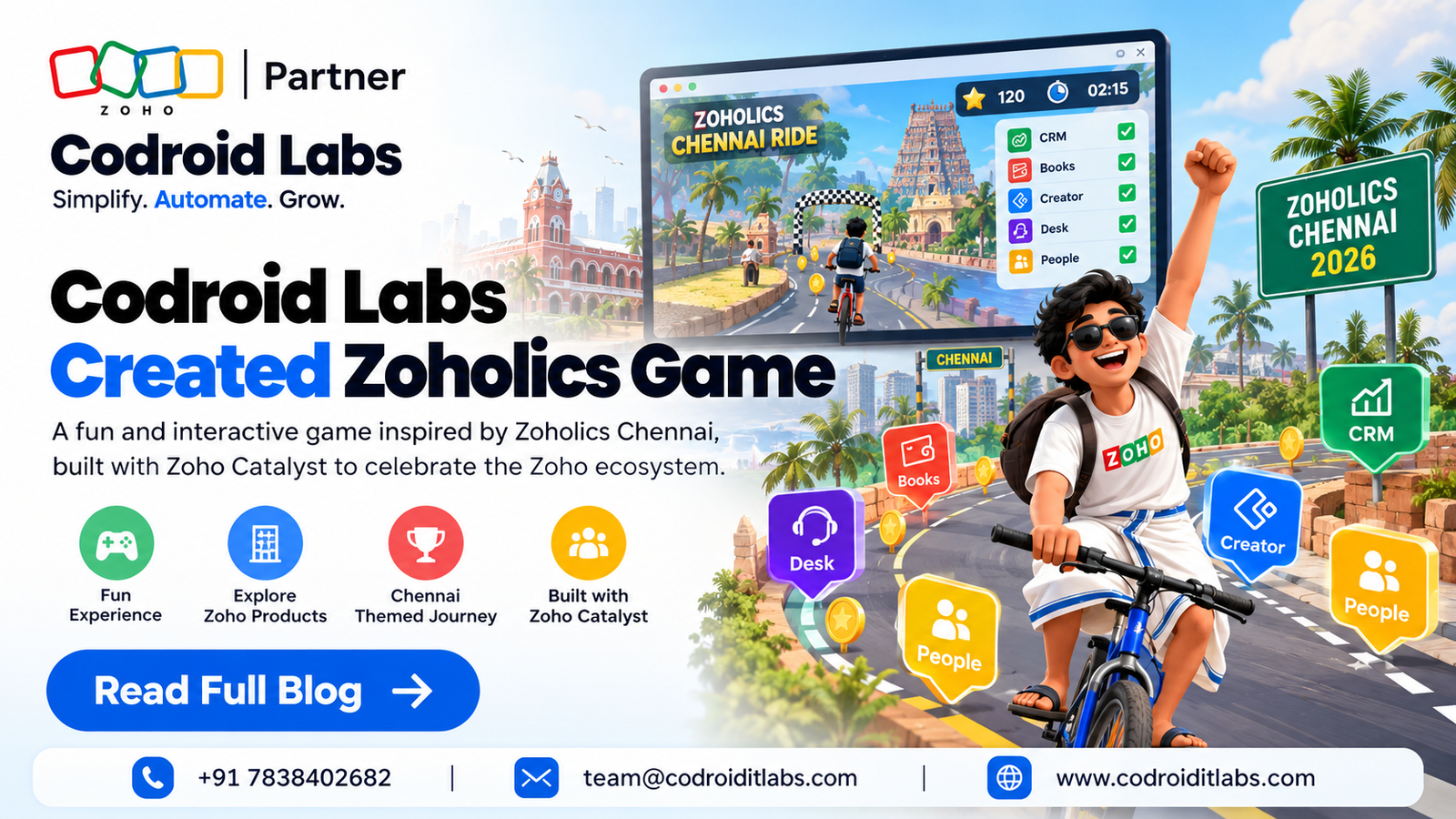
zoholics game is the primary idea behind a Codroid Labs side project that turns the event theme into an interactive ride. Instead of presenting a conventional landing page, the project uses a cycling-style game loop to create a small digital experience people can enter immediately.
The supplied live build is a browser-based experience. The concept is Chennai-inspired, uses a rider journey as the main interaction, and connects software-product ideas to points and checkpoints. A face-upload element was also part of the concept so the player can make the rider feel more personal.
The important part is not the novelty of putting a bicycle on screen. It is the decision to use interaction as the content itself. A product ecosystem is easier to remember when the visitor does something with it rather than reading a wall of feature bullets.
Why Codroid Labs Built a Zoholics Game
Event content often disappears as soon as the conference ends. A static recap can explain what happened, but a playable build can keep the event idea alive as a link people revisit and share.
For Codroid Labs, the zoholics game concept is also a demonstration of a broader development principle: software skills become easier to understand when they are packaged into a clear user experience.
The project also creates a bridge between technical implementation and marketing. The same build can be discussed as a React project, an interactive product demo, a branded campaign asset, a lightweight lead magnet or a community experiment. That makes the project useful beyond the game itself.
How the Zoholics Game Loop Works
The experience is easier to understand when broken into a simple loop:
| Stage | What the player experiences | Why it matters |
|---|---|---|
| Enter | Open the game and understand the objective. | Reduces cognitive load. |
| Ride | Move through a themed route. | Creates continuous interaction. |
| Collect | Pick up product-linked objects or points. | Makes product concepts tangible. |
| Personalize | Use the rider experience as a personal hook. | Increases emotional relevance. |
| Finish | See the outcome and share the experience. | Creates a natural return and referral point. |
How the Technical Build Comes Together
The project was created as a React-based interactive experience and deployed through Catalyst Slate. That combination fits the concept because the browser becomes the distribution channel: the user does not need to install a desktop client just to try a small game.
At a high level, the build can be thought of as four layers:
Interface
HUD elements, route visuals, buttons and responsive interaction.
Game state
Movement, score, collisions, checkpoints and session progress.
Personalization
The rider experience can use player-provided visual input.
Deployment
A hosted web build that can be opened through a shareable URL.
This architecture also keeps the product story understandable. A visitor sees a game, while a developer can see components, state management, event handling and deployment decisions underneath it.
Why Personalization Makes the Zoholics Game More Memorable
A generic demo asks the visitor to watch. Personalization asks the visitor to participate.
In this zoholics game concept, the rider is not just an anonymous character. The face-upload idea creates a clear moment of ownership: the experience becomes “my ride” rather than “someone else’s demo.”
For business websites, that same pattern can be reused without turning every page into a video game. Product configurators, onboarding mini-games, interactive estimators, quizzes and calculators all use the same underlying principle: give the visitor a small action that changes the experience.
Why a Zoholics Game Can Earn Organic Attention
Current search results around Zoholics are heavily weighted toward event pages, app listings and event recap content. That leaves a more specific content angle open: a practical case study about a playable community-style build rather than another event summary.
This case-study article therefore targets several intent layers at once: people searching the exact phrase, people looking for a Zoholics Chennai game, developers looking for a React game example, and business readers interested in interactive campaign ideas.
Content gap being targeted
- Exact-match topic: what is the zoholics game?
- Build intent: how was the experience designed?
- Technical intent: what makes a browser game practical for a campaign?
- Business intent: how can interactive content support awareness and lead capture?
This does not guarantee a particular Google position. Search visibility depends on indexing, content quality, authority, competition and how users respond over time. The useful part is that the page is built around a distinct first-party project rather than generic rewritten event information.
7 Practical Lessons From Building the Zoholics Game
- Start with one clear game loop. A player should understand what to do within seconds. Complexity can come later.
- Use the theme as mechanics, not decoration. The Chennai-inspired ride becomes useful when it changes what the player sees and does.
- Give products a job. Turning product ideas into points or checkpoints makes a large ecosystem easier to remember.
- Make personalization purposeful. A face-upload option should create a meaningful player moment, not exist just because a browser can access a camera or file input.
- Design for a URL first. A shareable web experience reduces friction for social posts, event recaps, QR codes and direct messaging.
- Publish the build story with the product. The game is one asset. The article, screenshots, short video clips and social posts become additional discoverable assets.
- Measure behavior, not vanity alone. Plays, repeat sessions, completion rate, share clicks and lead actions are more useful than impressions by themselves.
Access, Cost and What Is Actually Confirmed
The supplied live build is presented as a publicly reachable web experience. No commercial access price was supplied with the project brief, so this article does not invent a “game price” or claim a paid ticket is required to play it.
For implementation work, the cost is project-specific and depends on the interaction model, visual assets, personalization, analytics, deployment and integrations. A useful quote should come from scope rather than a made-up flat number.
What This Project Says About Modern Zoho Development
This project is interesting precisely because it is not another form, dashboard or CRUD screen. It shows how developers can combine a business software ecosystem with a lightweight consumer-style interaction.
That mindset is useful for training tools, onboarding portals, internal challenges, event campaigns and customer education. It also fits the broader direction of building custom experiences around business applications rather than forcing every problem into a stock screen.
Codroid Labs publishes practical work around automation, AI, customization and implementation. Related reading includes Zoho CRM workflow automation, building a Zia AI agent, Zia features and availability, and Zoho implementation services in India.
Build More Than a Demo
A useful custom build should make the business idea easier to understand, not simply make the screen look busy. Codroid Labs works on Zoho customization, automation and interactive web experiences for business use cases.
Quick Answers About the Zoholics Project
What is the Zoholics project?
It is a Codroid Labs-created interactive browser experience built around a Chennai-inspired cycling theme, product-style scoring and a personalized rider concept.
Is this a normal event webpage?
No. The project is designed as a playable web experience rather than a standard event information page.
What was used to build the project?
The project was created as a React-based interactive build and deployed through Catalyst Slate, based on the project details supplied for this article.
Can this concept be used for other businesses?
Yes. The same interaction pattern can be adapted for product onboarding, quizzes, campaign microsites, calculators, internal challenges and educational experiences.
Where can I play the build?
The live project is available at this public game URL.