


Direct Answer
Zoho Zia LLM is Zoho’s proprietary large language model designed for business-oriented generative AI. Zoho announced three model sizes: 1.3B, 2.6B and 7B parameters, trained for use cases such as structured data extraction, summarization, retrieval-augmented generation and code generation. In current product documentation, the native option may appear as Zoho Hosted LLM or Zoho GenAI depending on the product. The practical benefit is not simply having a smaller or larger model; it is the combination of the model, business context, product permissions, retrieval and workflow controls around it.
Zoho Zia LLM is Zoho’s proprietary large language model designed for business-oriented generative AI. Zoho announced three model sizes: 1.3B, 2.6B and 7B parameters, trained for use cases such as structured data extraction, summarization, retrieval-augmented generation and code generation. In current product documentation, the native option may appear as Zoho Hosted LLM or Zoho GenAI depending on the product. The practical benefit is not simply having a smaller or larger model; it is the combination of the model, business context, product permissions, retrieval and workflow controls around it.
Updated / Reviewed / From Codroid Labs
Updated: September 2026 | Reviewed: Public product documentation and launch coverage | Scope: India-first business use, AI governance and implementation
Updated: September 2026 | Reviewed: Public product documentation and launch coverage | Scope: India-first business use, AI governance and implementation
3
Announced model sizes
7B
Largest announced model
IN
India data-center support exists
2026
Current product landscape
What is Zoho Zia LLM?
Zoho Zia LLM is Zoho’s proprietary large language model for business-oriented AI. Zoho announced it in July 2025 as part of a wider AI stack that also included pre-built agents, an agent builder and an MCP server. The important distinction is that the model is only one layer. Zia is the broader intelligence layer, while the LLM supplies the language-generation capability underneath selected product features.
That difference matters because businesses do not buy an LLM in isolation. They buy outcomes: a shorter support response cycle, faster meeting summaries, cleaner data extraction, better candidate communication or less repetitive work for sales teams. Zoho’s model is designed around those workflows, with product context, permissions and retrieval logic sitting around the model.
The launch coverage describes the model as trained for structured data extraction, summarization, retrieval-augmented generation and code generation. In current product help, the native model can appear under labels such as Zoho Hosted LLM or Zoho GenAI. The naming is not perfectly uniform across products, which is one of the first things an implementation team should understand before comparing screenshots or plan pages.
Zoho Zia LLM model sizes, training and architecture
Zoho announced three Zia LLM sizes: 1.3 billion, 2.6 billion and 7 billion parameters. The idea is not that the biggest model must be used for every task. Smaller models can be more resource-efficient, while a larger model can be selected when the task benefits from more capacity. The launch materials explicitly describe this as a right-sizing strategy.
Zoho’s public model page states that the models were built from scratch using a mix of public and proprietary datasets, with training datasets ranging from roughly 2 trillion to 4 trillion tokens. The same page states that the final 7B model was trained on 128 H100 GPUs for 50 days. Those figures describe the model-development effort, not a customer-facing compute quota.
Zia vs Zia LLM vs Zoho Hosted LLM: the confusion nobody explains
Search for Zoho Zia LLM and you will find three names used close together. They are related, but they are not interchangeable.
The safest way to evaluate a feature is to check the current help page for the exact application you use. For example, current CRM documentation says Models can work with Zoho Hosted LLM or external LLM services, while Creator documentation describes Zoho GenAI as its natively integrated model option. That tells you something important: model availability is product-specific, not a single switch that magically enables the same experience everywhere.
Zoho Zia LLM availability in India: what businesses should know
India is an important part of the current availability picture. Current documentation shows native or Zoho-hosted AI options in the India data center for multiple product surfaces. For example, CRM Models is listed as available in the India data center, and current native-agent documentation lists India among supported data centers.
That does not mean every Zia feature, agent, language capability or model tier is available in every Indian account. Data-center coverage and edition requirements can differ by product. In other words, “available in India” is a useful starting point, not a complete entitlement statement.
There is also an important documentation gotcha: the original public Zia LLM landing page still contains older “coming soon” wording, while newer product documentation shows Zoho-hosted model options already being used. For buyers, the current product-specific help documentation should win over an older marketing page when determining what is actually deployable today.
7 practical Zoho Zia LLM use cases for businesses
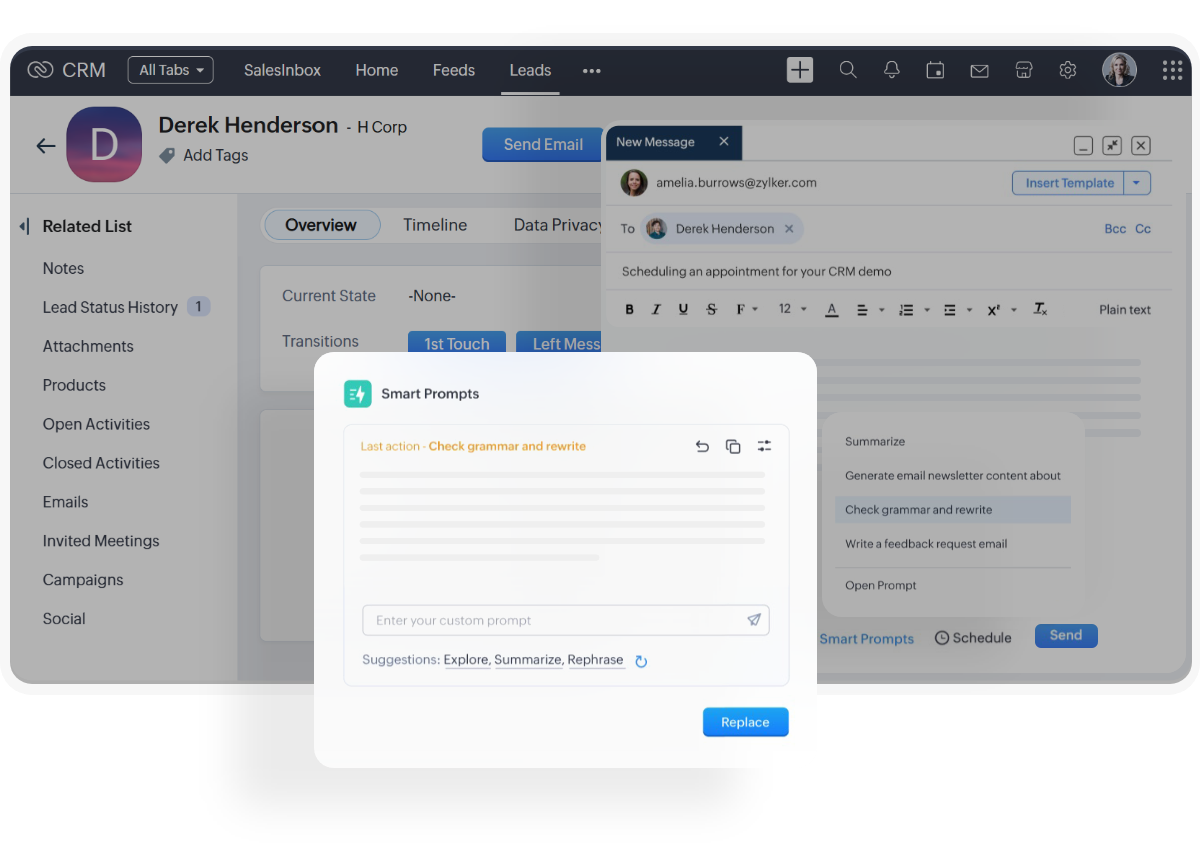
- Record and conversation summaries. In CRM, models can summarize records, notes and email conversations so users spend less time hunting for context.
- Email and content drafting. Zia-powered features can draft, rewrite, translate or improve business communication directly inside supported workflows.
- Structured data extraction. A model designed for business use becomes more valuable when the task is turning messy text into structured fields or reusable information.
- Retrieval-augmented answers. Instead of relying only on general model knowledge, the workflow can retrieve relevant business context first and generate from that context.
- Low-code development assistance. In Creator, Zia can help generate applications, forms, scripts, chat agents and other components from natural-language requirements.
- Recruitment assistance. Current Recruit documentation describes Zia as the default model for AI Assist use cases such as job descriptions, assessments and communication.
- Agentic automation. The 2025 launch paired the model with ready-to-deploy agents and an agent builder, shifting AI from “generate an answer” toward “complete a defined business task.”
9 Zoho Zia LLM gotchas before you deploy it
1. Zia is not the same as the LLM.
The AI layer, retrieval, prompts and permissions matter as much as the model.
The AI layer, retrieval, prompts and permissions matter as much as the model.
2. Availability is product-specific.
Check the application help page, data center and edition instead of assuming universal availability.
Check the application help page, data center and edition instead of assuming universal availability.
3. “In-house” does not mean every feature is identical.
Different products expose different capabilities around the native model.
Different products expose different capabilities around the native model.
4. Model size is not the whole story.
Grounding, retrieval, prompts and workflow controls can dominate the business result.
Grounding, retrieval, prompts and workflow controls can dominate the business result.
5. AI still needs review.
Generated text and scripts can be wrong. High-impact actions need human approval and testing.
Generated text and scripts can be wrong. High-impact actions need human approval and testing.
6. External model options can change the data boundary.
When a feature uses a third-party provider, its processing rules become part of your architecture.
When a feature uses a third-party provider, its processing rules become part of your architecture.
7. Pricing is not simply “the LLM price.”
The application subscription, AI capability, model usage and implementation effort can all matter.
The application subscription, AI capability, model usage and implementation effort can all matter.
8. Older documentation can mislead.
The public Zia LLM page has older availability wording, so use current application docs for entitlement decisions.
The public Zia LLM page has older availability wording, so use current application docs for entitlement decisions.
9. Do not automate a broken process.
AI amplifies a good workflow faster than it fixes a bad one. Map the process first.
AI amplifies a good workflow faster than it fixes a bad one. Map the process first.
Zoho Zia LLM pricing: what you actually pay in 2026
Here is the honest part: there is no single public per-user “Zoho Zia LLM” price that can be used across every Zoho application. The model is embedded into product features, and some newer agent experiences have their own consumption model.
The published agent pricing page also notes that the paid Pro-tier availability is currently on request in the US and India data centers and that local taxes such as GST are additional. Because AI pricing changes quickly, use the current product pricing page for a final commercial quote rather than copying a blog number into a purchase order. Humanity has suffered enough from spreadsheet archaeology.
A simple Zoho Zia LLM implementation plan
A reliable zoho zia llm rollout is not “turn on AI and hope.” Use this sequence:
- Pick one measurable workflow. Start with a use case where you can measure time saved, quality or completion rate.
- Confirm data-center and edition availability. Check the exact product documentation for your India account.
- Choose the model path. Use the native Zoho-hosted option where it fits your privacy and capability requirements; use an external model only when the product and governance model allow it.
- Design retrieval and permissions. Define which records, documents and fields the AI can access.
- Keep humans in the loop for consequential actions. Especially for finance, HR, customer commitments or production changes.
- Measure before scaling. Track response quality, processing time, adoption, false positives and AI usage cost.

Related Guides from Codroid Labs
- Zoho Zia Features & Availability Guide
- How to Build Your First Zoho AI Agent with Zia Agent Studio
- Zoho CRM Workflow Automation Guide
Primary references:, Zia LLM overview, CRM Models FAQ, Zia Agents pricing, and Creator Zia configuration.
Quick answers: Zoho Zia LLM FAQ
Is Zoho Zia LLM the same as Zia?
No. Zia is the broader AI layer and product experience. Zia LLM is the proprietary language model that can power supported AI capabilities.
Is Zoho Zia LLM available in India?
Native Zoho-hosted model options are available in multiple current product surfaces in the India data center, but exact availability depends on the application, data center and edition.
How many parameters does Zoho Zia LLM have?
Zoho announced 1.3B, 2.6B and 7B parameter models.
Does Zoho Zia LLM have a separate subscription price?
There is no single public per-user price for the model itself across Zoho. Costs depend on the product capability, plan and, for newer agent workflows, model usage.
Can I use an external LLM instead?
For several product surfaces, yes. Current documentation shows products that let administrators choose between the native Zoho-hosted option and supported external model providers. The choice changes the data-processing boundary and should be reviewed with your security and compliance requirements.
Turn Zoho AI Into a Business Workflow, Not Another Demo
Codroid Labs can help map the right Zia use case, confirm India data-center availability, design permissions, configure the workflow and measure the result before you scale AI across the business.
Product names, availability, plan entitlements and AI pricing can change. Verify the current product-specific documentation and commercial terms for your exact India data center before implementation.