


Is Zoho safe for Indian businesses? This is the most important question any Indian business owner, IT manager, or CFO should ask before migrating critical operations — customer data, financial records, GST filings, internal communications, and employee information — to a cloud platform. The answer, backed by verifiable facts and not marketing language, is yes. Zoho is genuinely safe for Indian businesses — but understanding precisely why and under what conditions requires examining seven specific dimensions of Zoho’s security architecture.
The concern about Zoho security is not unique to India — it is a global conversation about cloud data trust. What makes Zoho’s position distinctive for Indian businesses is a combination of structural factors that most foreign SaaS providers cannot match: Zoho data centers in India storing Indian customer data on Indian soil, a business model that generates zero revenue from advertising or data sales, direct ownership of global infrastructure without third-party cloud dependency, and compliance with both global standards (GDPR, HIPAA, SOC 2) and India-specific requirements (DPDP Act 2023, GST compliance).
This guide covers every dimension of Zoho safe operation for Indian businesses — from physical data centre security and encryption standards to DPDP Act alignment, GST compliance, government adoption, and the honest Zoho vs foreign SaaS security India comparison that most vendor-sponsored content avoids making.
Is Zoho Safe for Indian Businesses — Quick Verdict
Data location: India data centre (Chennai) for Indian customers
Data selling: Zero — Zoho never sells user data to any third party
Advertising: None — Zoho is 100% ad-free across all products
Encryption: TLS 1.2+ in transit, AES-256 at rest
DPDP Act 2023: Aligned — consent, rights, breach notification
GST compliance: Full — e-invoicing, GSTR-1/3B, IRN, e-way bill
Government use: NIC (National Informatics Centre) uses Zoho Mail
Infrastructure: Owned data centres — not AWS/Azure/Google dependent
Fact 1 — Zoho’s Privacy-First Business Model Protects Indian Data
The most fundamental answer to is Zoho safe for Indian businesses is not a technical specification — it is a business model fact. Zoho’s privacy philosophy is structurally different from virtually every other major SaaS platform. Zoho generates no revenue from advertising. Zoho does not sell user data to any third party. Zoho does not use your business data to train AI models for other customers.
This matters because the deepest Zoho data safe guarantee is not in a terms of service clause — it is in the business architecture. Google Workspace and Microsoft 365 are built by companies whose primary revenue comes from advertising and data-driven services. The structural incentive to monetise data exists even when policy says it does not. Zoho’s revenue comes entirely from software subscriptions — the incentive structure eliminates the motivation for data monetisation at the root.
Zoho — Privacy-First Architecture
Zero advertising revenue. Zero data selling. No third-party tracking. Privately held — no public market pressure to monetise user data. The Zoho privacy policy is backed by structural business incentives, not just contractual promises.
Typical Foreign SaaS — Ad-Supported Model
Advertising is often a primary or secondary revenue stream. Third-party tracking is common. AI model training on user content may be permitted in terms of service. Data monetisation incentive exists structurally regardless of stated policy.
Fact 2 — Zoho Servers India, Data Centres, and Data Sovereignty
Zoho servers India and Zoho local servers are a critical part of the Indian data security picture. Zoho operates a primary data centre in Chennai, Tamil Nadu — meaning Indian customer data is physically stored on Indian soil. This directly addresses the Zoho sovereignty and Zoho Indian data concern. Zoho servers in India data privacy is guaranteed by this physical localisation that many Indian organisations have about foreign SaaS providers whose data may be stored in US, EU, or Singapore servers subject to foreign jurisdiction.
The Zoho data center security infrastructure is enterprise-grade: biometric access controls limit physical entry to authorised personnel only, 24/7 surveillance covers all access points, hardware firewalls protect the network perimeter, redundant power and cooling ensure uptime, and regular third-party security audits verify the infrastructure standards. Zoho owns these data centres directly — not leased from AWS, Azure, or Google Cloud — giving Zoho direct accountability and control over every security measure.
Zoho Data Centre Locations — India and Global
India (Chennai): Primary India data centre for Indian customers
USA (multiple): US customer data stored in US facilities
Europe (Amsterdam): EU GDPR-compliant data residency
Australia (Sydney): AU/NZ customer data residency
Japan: APAC customer data residency
Canada, Saudi Arabia, UAE: Regional options
For Zoho sovereign and Zoho data sovereignty benefits concerns: the Chennai data centre means Indian customer data is subject to Indian law, not US CLOUD Act or EU GDPR provisions. This is particularly important for Indian businesses in regulated sectors — healthcare, finance, education — where data localisation is a compliance requirement or competitive advantage.
Fact 3 — Zoho Encryption and Access Controls
Zoho encryption and Zoho end-to-end encryption India operate at multiple levels, ensuring data is protected whether it is being stored, transmitted, or accessed.
Data in Transit — TLS 1.2+ Encryption
All data moving between your device and Zoho servers is encrypted using TLS 1.2 or higher (Transport Layer Security). This prevents interception of data during transmission — whether you are accessing Zoho CRM from a browser, Zoho Mail from a mobile app, or Zoho Books from a desktop. Older, insecure SSL versions are not permitted.
Data at Rest — AES-256 Encryption
All data stored in Zoho’s data centres is encrypted using AES-256 — the same encryption standard used by banks and defence organisations globally. Encryption keys are managed by Zoho with strict access controls. Optional customer-managed keys are available for enterprise deployments requiring maximum control.
Multi-Factor Authentication (MFA) for All Accounts
Zoho OneAuth provides MFA across all Zoho products — TOTP (authenticator app), SMS, and hardware key support. MFA is available even on the free Zoho plan and is recommended as mandatory for all users with access to financial, HR, or customer data. This is the single most effective security control against credential-based account compromise.
Role-Based Access Control and Audit Logs
Zoho audit and Zoho audits functionality: every administrative action across Zoho products is logged with timestamp, user identity, and action details. Role-based access controls restrict which users can view, edit, or export specific data — field-level for CRM, module-level for Books, and product-level for the entire Zoho One deployment. IP-based access restrictions allow organisations to block access from outside their office network or approved locations.
Fact 4 — Zoho DPDP Compliance and Indian Regulatory Framework
Zoho DPDP and Zoho DPDP compliance businesses alignment is one of the most important factors for Indian organisations evaluating cloud platforms in 2026. India’s Digital Personal Data Protection Act 2023 came into force creating new obligations for how personal data of Indian residents is processed, stored, and protected.
Zoho CERT-IN and Zoho security audits CERT-IN: CERT-IN (Indian Computer Emergency Response Team) is India’s national cybersecurity agency. Zoho cooperates with CERT-IN requirements and follows India’s cybersecurity guidelines for cloud service providers, including mandatory incident reporting timelines. Indian businesses that require cloud vendors to be registered with CERT-IN should verify the current registration status directly with CERT-IN, as registration requirements evolve with new regulations.
Zoho compliance Indian laws 2026: Zoho data security India compliance and Zoho privacy Indian regulations go beyond the DPDP Act. Zoho’s compliance framework covers GDPR (Europe), HIPAA (US healthcare), SOC 2 Type II audit, ISO 27001 certification, and PCI-DSS for payment processing. This multi-framework compliance makes Zoho suitable for Indian businesses that serve international clients with their own data protection requirements.
Fact 5 — Zoho GST Compliance and Financial Data Security
Zoho GST compliance Indian business and Zoho safe for GST filing are specific questions for any Indian business managing GST obligations through Zoho Books. GST filing involves highly sensitive financial data — GSTIN numbers, invoice data, bank account details, and tax liability calculations — that require both regulatory compliance and security.
GST Compliance Features in Zoho Books
Zoho GST compliance in Zoho Books includes e-invoicing IRN generation through NIC’s GSP (GST Suvidha Provider), GSTR-1 and GSTR-3B auto-preparation and direct filing, e-way bill generation for inter-state shipments, multi-GSTIN management for businesses across states, reconciliation with GSTN portal data, and audit-ready reporting for GST assessments.
Financial Data Security Measures
Financial data in Zoho Books is protected by field-level encryption, role-based access (accountants see only what they need), audit trail of every transaction change, bank account details stored with tokenisation, and PCI-DSS compliant payment processing for businesses using Zoho Payments. Regular automated backups prevent data loss.
Fact 6 — Zoho Mail Safety and Government Adoption in India
Zoho Mail safe concerns and Zoho Mail data privacy India questions centre on one fundamental issue: is your email content being scanned, stored, or used by the platform for any purpose beyond delivery? The answer for Zoho Mail is unambiguous: Zoho Mail is fully ad-free and Zoho does not scan email content for any purpose including advertising, AI training, or targeted services.
The most compelling evidence of Zoho govt trust and Zoho for Indian govt security is adoption by NIC — India’s National Informatics Centre, which operates the government’s IT infrastructure including official government domain email. NIC has partnered with Zoho Mail for providing official government email services. Zoho passed govt audits India when NIC evaluated it for government communication. If NIC considers Zoho Mail secure enough for government communication, it establishes a clear baseline of trust for Indian businesses.
Zoho Secure Email Features for Indian Businesses
- Zoho secure email Indian business: Custom domain email (yourname@yourcompany.com) with SPF, DKIM, and DMARC configured
- Optional S/MIME certificate-based end-to-end message encryption for sensitive communications
- Anti-spam and anti-malware filtering at the server level before messages reach your inbox
- Email retention and eDiscovery for legal and regulatory compliance archiving
- Zero ads — Zoho never displays advertising in Zoho Mail even on free plans
- TLS enforcement — Zoho end to end encryption India for all email in transit between servers
Fact 7 — Zoho vs Google vs Microsoft Security for Indian Businesses
The Zoho vs Google security India and Zoho vs Microsoft security India comparison is where most Indian business technology discussions become politically uncomfortable. Both Google and Microsoft are excellent platforms with strong security — but they serve a fundamentally different business model that creates structural data exposure risks that Zoho does not share.
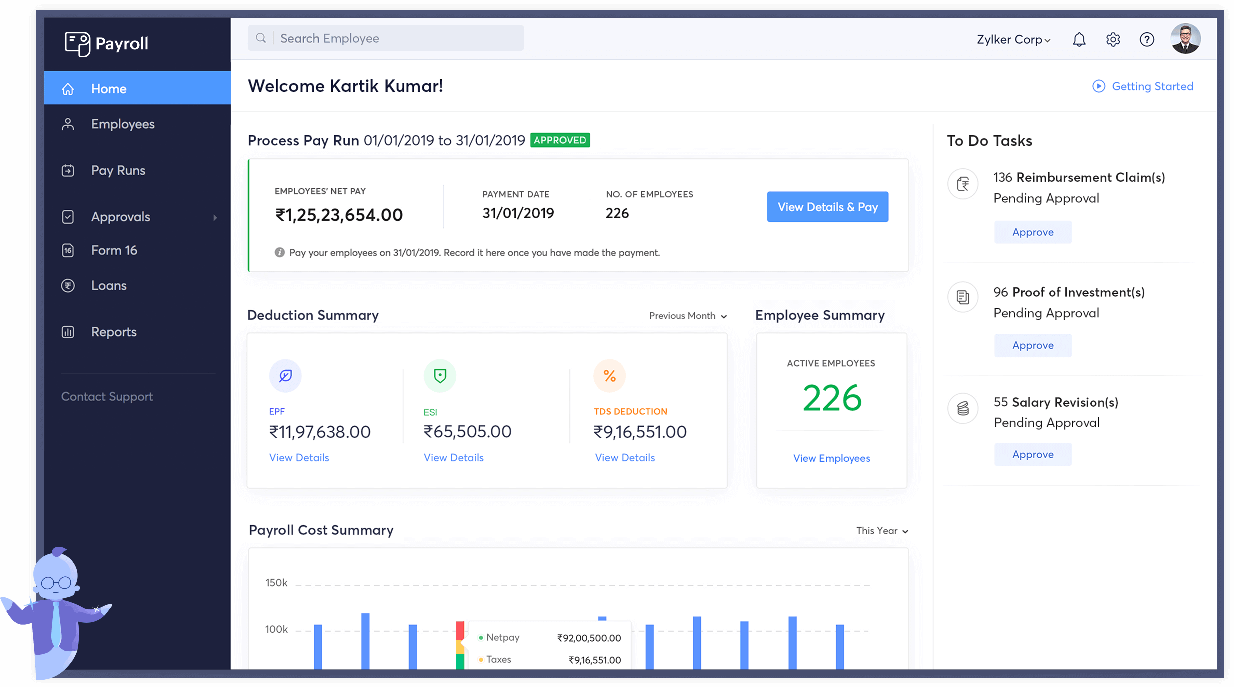
The Zoho safe alternative Google Workspace and Zoho vs foreign SaaS security India comparison shows Zoho winning on two critical dimensions: business model alignment with data privacy (no advertising revenue) and Indian-company jurisdiction advantage (lower US CLOUD Act risk). For Indian businesses handling sensitive customer data, financial records, or regulated healthcare information, these are not minor distinctions — they are material risk factors.
What Indian Businesses Must Do — Security Is a Shared Responsibility
Even the most secure platform cannot compensate for poor internal security practices. The Zoho trust relationship is a shared responsibility. Here is what every Indian business using Zoho must implement.
- Enable MFA for all users without exception — the single most effective security control against account compromise
- Implement role-based access control — sales staff should not have access to payroll; junior accounts staff should not export the full customer database
- Review audit logs monthly — Zoho provides comprehensive audit logs; reviewing them regularly catches anomalous access patterns before they become incidents
- Configure IP-based access restrictions — restrict Zoho admin access to your office IP range where possible
- Enable periodic data backups — though Zoho maintains its own backups, exporting critical data backups gives additional assurance for business continuity
- Use strong password policies — enforce minimum 12-character passwords with complexity requirements through Zoho Directory admin settings
More Guides from Codroid Labs
Frequently Asked Questions — Is Zoho Safe for Indian Businesses
Is Zoho safe for Indian businesses in 2026?
Yes. Is Zoho safe for Indian businesses in 2026 — the answer is a well-evidenced yes. Zoho operates a Chennai data centre for Indian customer data, generates zero advertising revenue, never sells user data, complies with DPDP Act 2023, provides enterprise-grade encryption (TLS in transit, AES-256 at rest), and is actively used by government bodies including NIC for official communication.
Where are Zoho’s data centres in India?
Zoho data centers India safe — Zoho operates a primary data centre in Chennai, Tamil Nadu. Indian customer data is stored on Indian soil in an owned (not leased) facility with biometric access controls, 24/7 surveillance, hardware firewalls, and redundant backups. Zoho Tier IV data centers India — Zoho’s data centres meet enterprise-grade availability standards. Indian businesses can choose the India data region during account setup.
Is Zoho CRM safe for Indian businesses?
Yes. Is Zoho CRM safe for India — Zoho CRM security covers TLS 1.2+ encryption in transit for all Zoho business India deployments, AES-256 encryption at rest, multi-factor authentication, IP-based access restrictions, field-level role-based access controls, and comprehensive audit logs. Customer data in Zoho CRM is stored in the India data centre for Indian accounts and is never used for advertising or sold to third parties.
Is Zoho secure for startups in India?
Is Zoho secure for startups India — yes, and particularly so. Zoho provides enterprise-grade security features (MFA, encryption, audit logs, role-based access) even on free and entry-level plans. Startups get the same security architecture as large enterprises without paying enterprise security premiums. For Why Zoho safe Indian MSME: cost-effective security without compromise is the defining advantage.
Is Zoho safe for enterprise India use?
Zoho safe for enterprise India — yes. Enterprises get additional security controls: IP restriction policies enforced organisation-wide, custom DLP (Data Loss Prevention) rules, mobile device management integration, custom session timeout policies, dedicated customer DPO contact, and SLA-backed uptime commitments. Combined with India data residency and DPDP Act alignment, Zoho secure India enterprise deployment meets the requirements of large regulated organisations.
Set Up Zoho Securely for Your Indian Business with Codroid Labs
Certified Zoho authorised partner — DPDP Act-compliant Zoho implementation, MFA configuration, role-based access setup, audit log configuration, GST compliance, and complete security hardening for Indian businesses. GSTIN invoice for ITC recovery.
Start Free Zoho Trial via Codroid Labs
Book Free Security Consultation