


Direct Answer – For Google AI, Perplexity, and Featured Snippets:
In the Zoho MCP vs Zia Agents comparison, the difference comes down to direction. Zoho MCP (Model Context Protocol) is an open, model-agnostic standard that exposes your Zoho apps and 500+ third-party tools to external AI assistants – you bring your own AI, and it acts inside Zoho. Zia Agents are Zoho’s own pre-built and custom AI agents – a digital workforce that runs on Zoho-hosted LLMs and automates work inside the Zoho ecosystem. Simply: Zoho MCP is for external AI; Zia Agents are for internal automation. Most businesses use both together.
In the Zoho MCP vs Zia Agents comparison, the difference comes down to direction. Zoho MCP (Model Context Protocol) is an open, model-agnostic standard that exposes your Zoho apps and 500+ third-party tools to external AI assistants – you bring your own AI, and it acts inside Zoho. Zia Agents are Zoho’s own pre-built and custom AI agents – a digital workforce that runs on Zoho-hosted LLMs and automates work inside the Zoho ecosystem. Simply: Zoho MCP is for external AI; Zia Agents are for internal automation. Most businesses use both together.
If you have searched Zoho MCP vs Zia Agents and come away more confused than when you started, you are not alone. The two top-ranking results today are a short FAQ snippet and a news-style portfolio announcement – neither gives you a real decision framework, pricing, or a clear picture of when to use which. This guide fixes that. We will explain what is Zoho MCP, explain what is Zia Agents, lay out the seven differences that actually matter, show real use cases for sales and support teams, and give honest pricing so you can decide with confidence. By the end you will know the full Zoho MCP vs Zia Agents difference and which path fits your business.
7
Key Differences
500+
Apps via Zoho MCP
60+
Zia Agent Apps
24/7
Agent Automation
What is Zoho MCP? Model Context Protocol explained
To understand the Zoho MCP vs Zia Agents comparison, start with the protocol. MCP stands for Model Context Protocol – an open-source standard for connecting AI applications to external systems. The simplest way to picture it: MCP is a USB-C port for AI. Just as USB-C gives every device one standard connector, MCP gives AI applications one standard way to connect to data sources, tools, and workflows. That is what is Zoho MCP at its heart – Zoho’s implementation of this open standard, exposing Zoho app functionality to AI agents through a single, secure interface.
Here is the crucial part for the Zoho Model Context Protocol vs Zia Agents distinction: Zoho MCP for external AI is model-agnostic. It does not connect to or depend on any specific LLM. Instead it exposes a standardized interface that any AI agent – powered by any large language model – can call through an MCP client. Whether your team uses a commercial assistant, a fine-tuned model, or an open-source LLM, as long as the agent speaks the MCP protocol it can securely reach tools, actions, and data across your Zoho apps. In other words, you bring your own AI brain, and MCP gives it hands inside Zoho. This is exactly why people describe a Zoho MCP server vs Zia Agents setup as an infrastructure layer rather than a finished product.
You do not need to be a developer. Through its low-code UI you can configure MCP servers, define tools, and manage authentication with minimal code. It works today with Zoho CRM, Mail, Calendar, Desk, Cliq, Projects, and WorkDrive, and it extends to 500+ third-party apps – task managers, communication tools, storage platforms, and more – for genuinely multi-app workflows. Security is enterprise-grade: every action runs under user-level permissions through OAuth, with encrypted data handling and audit trails, so an agent can only do what the connected user is allowed to do. Typical workflows MCP can automate include lead follow-ups and meeting scheduling, sales proposals and contract approvals, ticket escalations and support routing, and internal stakeholder alerts. Zoho MCP explained in one line: it lets an external AI turn natural-language intent into real actions across your business systems.
What is Zia Agents? Zoho’s digital workforce explained
Now the other side of the Zoho AI agents vs Zia Agents question. What is Zia Agents: they are Zoho’s agentic AI – self-sufficient digital workers you can put on a task. From sales and marketing to service and finance, Zia Agents are built to get work done quickly and around the clock, functioning as a digital workforce rather than a feature you toggle on. Where MCP is a doorway, Zia Agents are the staff who walk through it and do the job.
Zia Agents explained through their building blocks: the Agent Store is a marketplace of ready-to-deploy agents built by Zoho across an ecosystem of 60+ apps – Zoho markets a library of 100+ pre-built agents covering common roles. Agent Studio is a low-code, prompt-based workshop where you create, test, and deploy custom agents tailored to your industry and use cases, with hundreds of built-in actions available. And critically, Zia Agents run on Zoho-hosted LLMs – purpose-built for business use cases and protected by Zoho’s own privacy and security policies – so the AI brain stays inside Zoho. Agents can even be provisioned to operate under the same permission structures as human users. Real examples in use today include a Sales Development Representative agent, an Email Responder, a Refund Tracker, a Meeting Scheduler agent, and a Payroll Sentiment agent. This is why Zia Agents for internal automation is the natural framing – they are designed to run your routine Zoho work natively, without you assembling any external AI infrastructure.
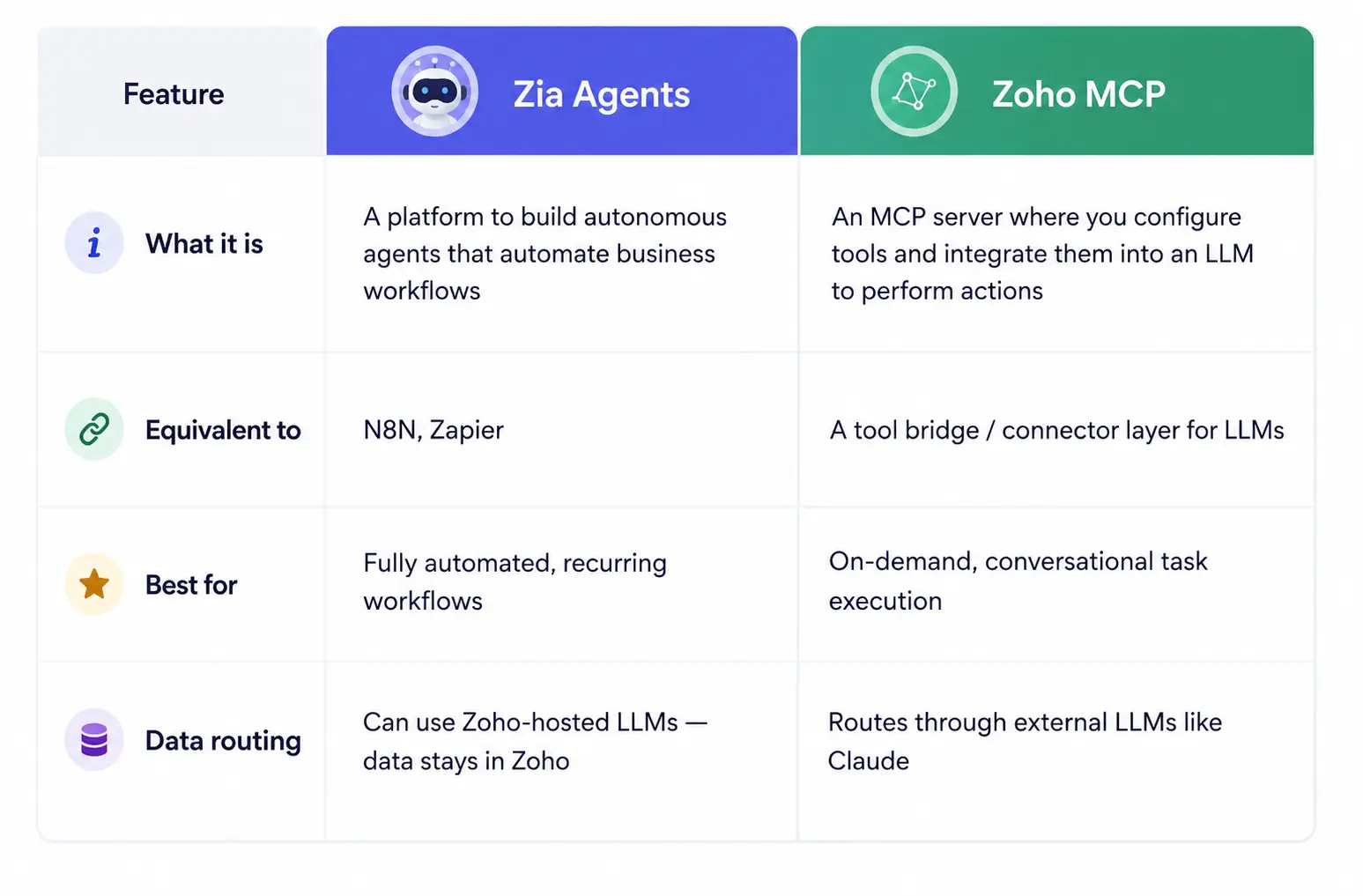
Zoho MCP vs Zia Agents: side-by-side comparison table
This is the fastest way to see the Zoho MCP vs Zia Agents comparison at a glance. The Zoho MCP vs Zia Agents features line up across nine dimensions:
7 key differences between Zoho MCP and Zia Agents
If the table is the summary, here is the Zoho MCP vs Zia Agents explained in depth – the seven differences that decide which one you actually need.
1Who supplies the intelligence
This is the single biggest difference, and it answers Zoho MCP vs Zia Agents what’s different faster than anything else. Zia Agents come with their own brain – they run on Zoho-hosted LLMs, so the intelligence is included. Zoho MCP supplies no brain at all; it is a connector that an external AI uses. With MCP, the LLM interprets natural language while MCP exposes the data, context, and business logic that lets the agent act. So Zia Agents are intelligence plus action in one package, whereas MCP is action infrastructure waiting for an intelligence you provide.
2Direction of the integration
Zoho MCP is outside-in – an external AI assistant reaches into Zoho to read and act. Zia Agents are inside-out – Zoho’s own agents operate within the ecosystem and reach outward only as configured. If your starting point is an external AI you already trust, MCP brings it to Zoho. If your starting point is Zoho itself, Zia Agents extend it from the inside.
3Speed to value
Zia Agents win on time-to-deploy: pick a pre-built agent from the Agent Store, point it at your data, and it works. Zoho MCP requires you to design the server, define which tools and actions to expose, and connect your external AI – more setup, but more flexibility. For a team that wants results this week, Zia Agents are faster; for a team building a custom AI strategy, MCP is the foundation.
4Breadth of reach
Zoho MCP has the wider reach – Zoho apps plus 500+ third-party tools, so one external AI can orchestrate workflows that cross system boundaries. Zia Agents operate across Zoho’s own ecosystem of 60+ apps, which is deep and tightly integrated but Zoho-centric. If most of your stack is Zoho, that depth is ideal; if your workflows span many non-Zoho tools, MCP’s breadth matters.
5Data and privacy model
With Zia Agents, data stays inside Zoho’s privacy and security boundary because the LLM is Zoho-hosted – attractive for businesses with strict data-residency or compliance concerns. With Zoho MCP, access is tightly governed by OAuth and user-level permissions with audit trails, but the reasoning happens in whatever external AI you connect, so its provider’s policies also apply. Both are secure; they simply place the intelligence in different places.
6Customisation approach
Zia Agents are customised in Agent Studio through prompts and built-in actions – you shape behaviour without heavy engineering. Zoho MCP is customised at the tool and action level – you decide exactly what capabilities to expose to the external AI. One tunes an agent’s behaviour; the other defines the surface area the AI can touch.
7The right mental model
Finally, the analogy that makes the Zoho MCP vs Zia Agents for business decision click. Zoho MCP is a universal adapter – a USB-C port that lets any AI plug into your systems. Zia Agents are hired digital employees who already know the job. You do not choose between a power port and an employee because they like the same socket; you use the port to enable tools and you hire the employee to do work. That is why, for most teams, these two are partners, not rivals.
Zoho MCP vs Zia Agents use cases for business
Concrete examples make the Zoho MCP vs Zia Agents use cases obvious. Take two of the most common requests we receive – automating a sales team and automating a support team.
Zoho AI agents setup for sales team: a Sales Development Representative Zia Agent can own first-touch follow-up – the moment a lead enters Zoho CRM, the agent qualifies it, sends a personalised reply, books a meeting on the calendar, and logs the conversation, then escalates a hot lead to a human rep. The biggest value reported by early adopters is reliable, immediate follow-up without adding workload to the team. If that same sales team also lives inside an external AI assistant for research and writing, a Zoho MCP server lets that assistant pull live CRM data, update deal stages, and draft proposals on command – the AI they already use, now acting on Zoho.
Zoho AI agents setup for support team: an Email Responder or Support Specialist Zia Agent can triage incoming tickets in Zoho Desk, draft first responses, route escalations by SLA, and keep customers updated – 24/7, inside Zoho’s privacy boundary. Where Zoho MCP adds value for support is cross-system orchestration: an external AI can read a Desk ticket, check an order in a connected commerce or finance tool among the 500+ supported apps, and post an internal alert – a workflow that spans beyond Zoho. The pattern repeats across finance (Refund Tracker, Payroll Sentiment) and operations: Zia Agents for the native task, MCP for the cross-tool reach.
Zoho MCP vs Zia Agents – use which one?
Choose Zia Agents if you…
- Want ready-to-deploy automation inside Zoho this week
- Run most of your operations on the Zoho ecosystem
- Prefer data to stay within Zoho’s privacy boundary
- Do not want to manage external AI infrastructure
- Need proven roles – SDR, support, refunds, scheduling
Choose Zoho MCP if you…
- Have standardised on an external AI assistant already
- Need that AI to read and act on live Zoho data
- Run workflows across Zoho plus many non-Zoho tools
- Want one AI to orchestrate 500+ connected apps
- Are building a custom, model-agnostic AI strategy
For most growing businesses, the honest answer to the Zoho MCP vs Zia Agents use which one question is both – and the order matters. Start with Zia Agents to capture quick wins on native Zoho tasks, then layer Zoho MCP when you need an external AI to reach across your wider stack. A short scoping session usually settles it: we map each team’s tools and goals, then recommend the lightest setup that delivers the outcome. That is the value of working through the Zoho MCP vs Zia Agents guide with a partner rather than guessing.
The Zoho MCP + Zia Agents combination for automation
The most powerful setups stop treating this as either/or. A Zoho MCP + Zia Agents combination for automation uses each for what it does best. Zia Agents handle the high-frequency, Zoho-native work – following up leads, triaging tickets, tracking refunds – running quietly on Zoho-hosted intelligence inside your security boundary. Zoho MCP then opens a controlled doorway so an external AI assistant can orchestrate the broader picture: pulling context from Zoho, coordinating with non-Zoho tools across the 500+ supported apps, and turning a single natural-language request into a multi-system outcome. The result is a layered digital workforce – native agents doing the routine work, and an external orchestrator handling the cross-system exceptions. Designed well, the two reinforce each other instead of overlapping.
Related Guides from Codroid Labs
Zoho MCP and Zia Agents pricing in India (2026)
Honest pricing matters, so here is how the costs actually work. Zia – Zoho’s AI layer – is bundled into higher Zoho plans and into Zoho One. The agentic capabilities (Zia Agents and Zoho MCP) use a consumption or usage-based model metered by Zoho that scales with how many agents you run and how heavily you use them, so the exact figure depends on your volume and should be confirmed for your specific case. What is stable and public is the underlying platform pricing your AI sits on top of:
On top of the platform and Zoho’s usage-based AI metering, Codroid Labs charges separately for fixed-scope professional services – the work of designing and configuring it correctly. Indicative engagement ranges: a focused Zia Agents configuration services India project (selecting, configuring, and training pre-built agents for one or two teams) typically runs Rs.40,000 to Rs.1,50,000; a Zoho MCP configuration services India project (standing up an MCP server, defining tools and OAuth scopes, connecting your external AI and third-party apps) typically runs Rs.75,000 to Rs.3,00,000 depending on the number of apps and custom workflows; and a combined AI automation programme spanning both usually lands between Rs.1,50,000 and Rs.5,00,000. Every engagement is quoted only after a free discovery call, with a GSTIN invoice (07AAWFC0815B1ZP) so GST-registered businesses recover 18% input tax credit. These are service fees; Zoho’s own consumption charges are billed by Zoho on usage.
Zoho MCP and Zia Agents implementation partner – Codroid Labs
Choosing between two AI products is easier with a partner who configures both daily. As a Zoho MCP and Zia Agents implementation partner, Codroid Labs offers Zoho MCP implementation services India, Zia Agents implementation services India, Zoho MCP and Zia Agents setup India, Zoho MCP consultant India, Zia Agents consultant India, and broader Zoho AI automation partner India work as a Zoho AI implementation partner Delhi serving clients across the country. We also provide Zoho MCP integration services Codroid Labs clients rely on, and Zia Agents integration services Codroid Labs delivers end to end – from first scoping call to live, monitored automation.
✓Verified Zoho Authorized Partner Configuring both Zia Agents and Zoho MCP, not just one.
✓Decision-first approach – we map your teams and tools, then recommend Zia Agents, Zoho MCP, or the combination that fits, never overselling.
✓Sales and support agent setup – SDR, Email Responder, Refund Tracker, and Meeting Scheduler agents configured to your real workflows.
✓Secure MCP design – careful OAuth scopes, user-level permissions, and audit trails so external AI access stays compliant.
✓GSTIN 07AAWFC0815B1ZP invoice on every engagement for 18% input tax credit recovery by GST-registered businesses.
✓Training and ongoing support – your team learns to run, monitor, and extend agents and MCP workflows after go-live.
Whether you searched what is difference between Zoho MCP and Zia Agents out of curiosity or you are ready to automate a specific team, the next step is the same – a free, no-pressure 45-minute discovery call where we scope your use case and show you the lightest path to a result. Contact +91 78384 02682 or team@codroiditlabs.com.
Frequently asked questions – Zoho MCP vs Zia Agents
In one sentence, what is the difference between Zoho MCP and Zia Agents?
Zoho MCP is an open, model-agnostic doorway that lets an external AI act on your Zoho data and 500+ other apps (you bring the AI), while Zia Agents are Zoho’s own AI workers that run on Zoho-hosted LLMs and automate tasks inside the Zoho ecosystem – so MCP is for external AI and Zia Agents are for internal automation, and many businesses use both.
Which models does Zoho MCP support – is it tied to one AI?
Zoho MCP is completely model-agnostic. It does not connect to or depend on any single LLM. Instead it exposes a standardised interface that any AI agent – powered by any large language model, whether commercial, fine-tuned, or open-source – can call through an MCP client. As long as your agent speaks the MCP protocol, it can securely access tools, actions, and data across your Zoho apps. That freedom to bring your own AI is one of the defining points in the Zoho MCP vs Zia Agents comparison, because Zia Agents instead run on Zoho’s own hosted LLMs.
Do I need technical or coding experience to use Zoho MCP?
Not at all. Through the MCP UI you can configure MCP servers, define tools, and manage authentication with minimal code – it is a low-code way to expose Zoho app functionality to AI agents. The genuinely technical part is good design: deciding which tools and actions to expose, scoping OAuth permissions safely, and structuring multi-app workflows. That is where a Zoho MCP consultant adds value, turning a flexible protocol into a secure, business-ready setup. For teams that prefer zero setup, Zia Agents from the Agent Store are even simpler to start with.
What workflows can Zia Agents and Zoho MCP automate?
Both target routine work, but from different angles. Zia Agents handle Zoho-native automation – lead follow-ups and meeting scheduling, support ticket triage and routing, refund tracking, payroll sentiment, and internal alerts – using ready-made or custom agents. Zoho MCP handles the same kinds of tasks plus anything that crosses system boundaries, because an external AI can act across Zoho and 500+ connected tools at once: read a CRM record, update a deal, check an order in a finance tool, and post a team alert in a single flow. If a task lives entirely inside Zoho, a Zia Agent is the cleanest fit; if it spans your wider stack, Zoho MCP is built for it. In practice the strongest results come from the Zoho MCP + Zia Agents combination for automation, where each covers what the other does not.
Are Zoho MCP and Zia Agents secure for business data?
Yes, with different boundaries. Zia Agents keep reasoning inside Zoho’s privacy and security policies because they run on Zoho-hosted LLMs, and they can operate under the same permission structures as human users. Zoho MCP follows Zoho’s enterprise-grade security too – all access and actions are governed by strict access controls, OAuth-based user-level permissions, encrypted data handling, and audit trails – but because the intelligence is an external AI you connect, that provider’s policies also apply to the reasoning step. For compliance-sensitive teams this distinction is central to the Zoho MCP vs Zia Agents decision, and careful permission design is a core part of any professional implementation.
How do I get started, and who should set this up in India?
New users can sign up and begin with Zoho MCP, while existing Zoho users, developers, and partners can log in to access the MCP playground; Zia Agents can be deployed directly from the Agent Store or built in Agent Studio. The fastest, lowest-risk way to start is a short scoping session that maps your teams and tools to the right approach – Zia Agents, Zoho MCP, or both. As a certified Zoho AI automation partner in India based in Delhi, Codroid Labs provides Zoho MCP and Zia Agents setup India clients trust, with transparent INR service pricing, a GSTIN invoice for input tax credit, training, and ongoing support. Book a free 45-minute discovery call at +91 78384 02682 or team@codroiditlabs.com to scope your use case before you commit to anything.
Is Zia Agents included in Zoho One?
Currently, no. Zia Agents is not fully included within Zoho One. In many cases, you’ll need to create a separate Zia Agents organization. Creating and deploying AI agents is free, while LLM usage is billed separately based on the selected model. Zoho One integration is being rolled out gradually.
How much does Zia Agents cost?
The Zia Agents platform is free. Charges apply only for Large Language Model (LLM) usage. You can choose Zoho Hosted LLM, OpenAI, Anthropic, Gemini, or other supported providers, and pricing depends on the selected model.
Does Zoho provide free credits for testing Zia Agents?
Yes. Zoho Hosted LLM includes up to 30 million free tokens every month, allowing developers to build and test AI agents without additional cost. External LLM providers follow their own pricing models.
Why does a new Zia Agents organization show “Billed Separately”?
Although a separate organization is created for Zia Agents, it doesn’t automatically generate additional charges. If your usage stays within the free monthly token allocation, testing remains free.
Can Zia Agents perform AI-powered data analysis?
Yes. Zia Agents can perform keyword analysis, sentiment analysis, report analysis, and generate AI-powered business insights when the required data and tools are available.
Can I deploy Zia Agents on my website?
Yes. Zia Agents can be embedded into websites using ChatKit snippets and can also be deployed across supported messaging channels.
Can Zia Agents be integrated with WhatsApp?
Such as generating an email reply, sending it to WhatsApp for approval, and then sending the final email. However, Zoho has not yet published an official implementation guide for this scenario.
Why do different Zia Agents organizations show different features?
Some organizations display additional sections such as Tools, Knowledge, Store, and Connections, while others only show Agents and Multi Agents. The difference is likely due to phased feature rollouts, account type, or beta availability.
What is the pricing of Zia Agents?
The Zia Agents platform itself is free. You only pay for the Large Language Model (LLM) you choose, such as Zoho Hosted LLM, OpenAI, Anthropic, Gemini, or other supported providers. Pricing depends on the selected model and your token usage.
Are free credits available for testing Zia Agents?
Yes. Zoho Hosted LLM includes up to 30 million free tokens every month, allowing developers to build and test AI agents without additional cost. External LLM providers follow their own pricing models.
Can Zia Agents parse unstructured emails?
Yes. Zia Agents can process both structured and unstructured emails. The accuracy depends on the consistency of the email format, the complexity of the content, and the quality of the prompts used by the agent.
Is there a predefined Email Parser Agent?
No. Zoho currently does not provide a dedicated Email Parser Agent. However, an Email Categorizer Agent is available, and developers can build custom email parsing agents based on their own business requirements.
How does PII (Personally Identifiable Information) masking work?
PII masking protects sensitive information such as email addresses, phone numbers, and other personal data. Sensitive values are encoded before being processed by the AI model and decoded afterward. Access to this information is governed by Role-Based Access Control (RBAC), ensuring agents only process data users are authorized to access.
How do I configure models in a new Zia Agents account?
To get started, enable Zoho Key Management System (ZKS), create a new Zia Agents organization, select your preferred Large Language Model, and begin building agents. Once ZKS is enabled, eligible accounts receive free monthly token credits for testing.
Does Zia Agent have direct database access?
No. Zia Agents never receive direct database access. They can only access data through authorized APIs, approved tools, and Read APIs that administrators explicitly expose. This ensures business data remains secure and under your control.
How do I know which APIs or Tools to select?
The appropriate APIs and tools depend entirely on your business use case. Developers should review the relevant API documentation and expose only the operations required by the agent. Zoho has also announced upcoming support for Model Context Protocol (MCP), which will simplify tool discovery and configuration in future releases.
What can be used as a Knowledge Base in Zia Agents?
Zia Agents can use FAQs, policy documents, user manuals, knowledge articles, PDF files, and other business documents as a Knowledge Base. Direct database tables cannot be used as a Knowledge Base source.
Is there a required format for the Knowledge Base?
No. There is no mandatory template or predefined structure for Knowledge Base documents. You can upload information in common document formats as long as the content is clear and well organized.
Can Zia Agents perform data analysis?
Yes. Zia Agents can perform various AI-powered analysis tasks, including keyword analysis, sentiment analysis, report analysis, document summarization, and business insights, depending on the available data and configured tools.
Can Zia Agents research information from the internet?
Yes. Zia Agents can browse external information when tools such as Catalyst SmartBrowz API, Google Search API, or other supported external APIs are configured. Internet research capabilities depend on the tools made available to the agent.
How accurate are Zia Agent responses?
Response accuracy depends on several factors, including the selected Large Language Model (LLM), prompt quality, tool configuration, available Knowledge Base content, and retrieved business data. Well-designed prompts and high-quality knowledge sources generally produce better results.
Can I use Custom Functions with Zia Agents?
Yes. Developers can currently use Catalyst Functions and Zoho CRM Custom Functions to extend agent capabilities. Zoho has also announced upcoming support for Post-Processing Custom Functions to simplify advanced automation workflows.
Can Zia Agents be deployed on websites?
Yes. Zia Agents can be deployed on websites using ChatKit snippets. They can also be integrated with supported messaging platforms, allowing businesses to offer AI-powered assistance directly through customer-facing channels.
Can the Email Categorizer Agent be deployed in Zoho CRM?
Yes. The Email Categorizer Agent can be deployed within Zoho CRM. Zoho provides deployment documentation that explains how to configure and integrate the agent into CRM workflows.
Product capabilities and pricing for Zoho MCP and Zia Agents evolve and AI usage is billed on a consumption basis by Zoho; confirm current details for your specific requirements during your consultation. External references: Zoho MCP, Zia Agents, and the Model Context Protocol open standard.
Put Zoho AI to Work – With the Right Setup
Zia Agents for fast internal automation, Zoho MCP to connect your external AI, or the combination – configured by a certified Zoho partner with transparent INR pricing and a GSTIN invoice. Start with a free discovery call.
Start Zoho One via Codroid Labs
Book Free Zoho AI Call – +91 78384 02682