



The Introduction
Choosing the right accounting software is the most critical financial decision a business owner makes. In the Indian subcontinent, the choice often boils down to a single, high-stakes question: Zoho Books vs Tally Prime.
It’s a classic battle between a proven desktop veteran and a modern, cloud-native challenger. Both are GST-compliant and capable, but their underlying philosophy—and the resulting feature set—could not be more different. This detailed comparison of Zoho Books vs Tally Prime will cut through the noise, covering everything from core accounting to pricing, and integrations, ensuring you make a decision that powers your business growth into 2025 and beyond.
Ready to find out the difference between Tally and Zoho Books and determine which is better for your specific needs? Let’s dive into the core comparison.
Table of Contents
1. Cloud-Native vs. Desktop-First: The Fundamental Difference
The most significant difference between the two platforms lies in their deployment model. This determines everything from accessibility to cost of ownership.
| Feature | Zoho Books | Tally Prime |
| Deployment Model | 100% Cloud-Native (SaaS) | Desktop-First (On-Premise) |
| Accessibility | Anytime, Anywhere via Web Browser or Mobile App | Primarily on a local PC; remote access requires additional setup (e.g., Tally on Cloud/VPN) |
| Data Backup | Automatic, secure, multi-layer encryption in the cloud | User is responsible for local backup and data security |
| Real-Time Data | Yes, absolutely—instant updates across all user devices | No, not natively. Real-time access across branches requires complex syncing. |
The Modern Business Takeaway: If your team is remote, or you need real-time data to make instant decisions, Zoho Books (a cloud platform) is inherently better suited than Tally Prime (a desktop solution).
2. Feature Face-Off: The Core Comparison
When we look beyond deployment, the answer to “Zoho Books vs Tally Prime which is better” depends entirely on your business type.
2.1. Automation & Workflow
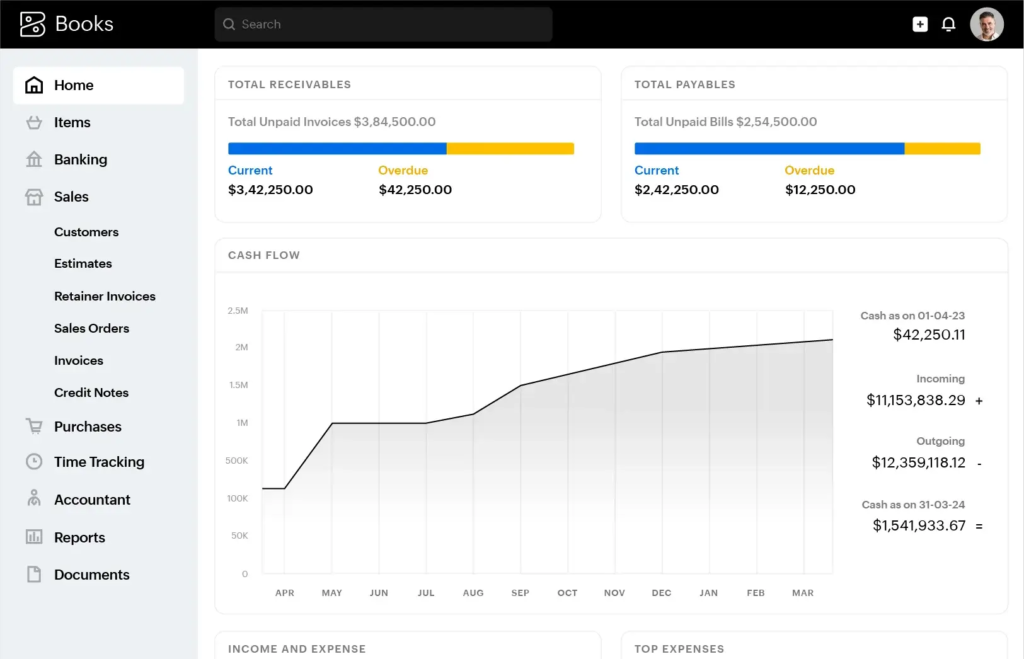
Zoho Books is designed for efficiency. Its strength is in automating repetitive finance tasks, which is where it significantly pulls ahead of Tally.
- Zoho Books: Offers robust workflow automation. You can set up smart, trigger-based actions like sending automatic payment reminders, creating recurring invoices, and setting up multi-level approval flows for purchases. This reduces manual intervention and human error.
- Tally Prime: Offers core automation features like automatic bank reconciliation (BRS), but complex workflow automation requires custom coding (Tally Definition Language – TDL) or third-party add-ons. It is more manual and keyboard-driven, often preferred by veteran accountants.
2.2. Inventory Management
This is where Tally Prime showcases its historical strength, especially for manufacturing and traditional trading businesses.
- Tally Prime: Provides highly detailed, advanced inventory control, including deep features like multi-level godown management, complex batch tracking, and manufacturing flow support.
- Zoho Books: Offers strong basic-to-intermediate inventory management perfectly suited for retail, trading, and service businesses. For complex manufacturing or ERP-level inventory, it seamlessly integrates with Zoho Inventory for an enterprise-grade solution.
2.3. Multi-Company & Multi-Currency Support
For businesses with global ambitions or multiple legal entities, this feature is non-negotiable.
- Zoho Books: Supports multi-currency handling with real-time exchange rate updates and makes managing multiple company accounts seamless, all from a single login dashboard.
- Tally Prime: Has multi-currency capabilities but requires separate licensing for different companies, and managing data from multiple entities is not as natively centralized as a cloud solution.
3. The Crucial Question: Zoho Books vs Tally Prime Price
One of the most frequently searched terms is Zoho Books vs Tally Prime price. Here is the key breakdown you need to understand the true cost.
| Aspect | Zoho Books Pricing (India) | Tally Prime Pricing (India) |
| Model | Subscription (Monthly/Annual) | Perpetual License (One-Time Cost) |
| Entry Point | Free Plan (For businesses under $\approx ₹25$ Lakhs/year) | Single-User Perpetual License $\approx ₹18,000 + GST$ |
| Multi-User | User-based subscription pricing (Scales smoothly) | Multi-User Perpetual License $\approx ₹54,000 + GST$ |
| Updates/Compliance | Included in the subscription (Auto-updated) | Requires Annual Maintenance Contract (AMC) for continuous updates and support |
3.1. Total Cost of Ownership (TCO)
While Tally Prime has a higher one-time upfront cost, Zoho Books is subscription-based.
- Zoho Books: Offers a low entry barrier, ideal for startups and freelancers. TCO is predictable (a monthly/annual fee).
- Tally Prime: Over many years, the TCO can be lower, provided you do not require frequent upgrades, support, or additional modules. The initial cost is a significant barrier for micro-businesses.
4. GST & Compliance: Zoho Books vs Tally Prime for Indian Businesses
Both platforms are fully GST-compliant, but their method of compliance differs.
- Zoho Books: Excels in automation. It features direct integration with the GSTN portal for automated filing of GSTR-1, GSTR-3B, and GSTR-9, along with error-checking tools before submission. The cloud platform ensures you are always on the latest version for compliance.
- Tally Prime: Also offers full GST compliance, including e-Invoicing and e-Way Bill generation, but the process often involves more manual steps, such as exporting files for upload, which can increase the administrative burden.
5. Integrations & Scalability: The Zoho Ecosystem Advantage
For a growing business, your accounting software can’t be an island. It must communicate with your CRM, Inventory, HR, and Sales tools.
This is arguably the most compelling case for Zoho Books vs Tally Prime.
As a Zoho Partner, we emphasize that Zoho Books is part of the massive Zoho suite of over 50 applications. It offers native, seamless, no-code integrations with:
- Zoho CRM: Turn sales orders into invoices instantly.
- Zoho Inventory: Advanced stock and warehouse management.
- Payment Gateways: Razorpay, Paytm, PayPal, etc.
- External Apps: Google Workspace, Microsoft 365, and hundreds more via custom API or platforms like Zapier.
While Tally Prime has an API and an active partner network, integrations usually require TDL coding or third-party middleware, adding complexity and cost. If you plan to scale your business operations beyond just accounting, the out-of-the-box integration capabilities of Zoho Books give you a massive advantage.
6. Final Verdict: Zoho Books vs Tally Prime—Which is Better for You?
The answer to which is better depends entirely on your business DNA.
| Choose Zoho Books if… | Choose Tally Prime if… |
| You are a startup, freelancer, or modern SME that values mobility and automation. | You are a traditional trader, manufacturer, or large enterprise that needs deep, custom inventory. |
| You need real-time, multi-user, remote access to your data (Cloud-First). | Your business operates with poor internet connectivity and requires robust offline stability (Desktop-First). |
| You plan to integrate your accounting with CRM, Sales, HR, or other modern business apps (Ecosystem). | Your in-house accountants are already comfortable with the traditional, keyboard-driven Tally interface. |
| You want a lower entry-cost (Free plan) and predictable subscription budgeting. | You prefer a higher one-time perpetual license and have a low reliance on external partner support. |
For the majority of modern, growth-focused SMEs, the automation, scalability, lower entry cost, and seamless integration offered by Zoho Books make it the clear choice for future-proofing your business finances.
Ready to Get Started on Zoho?
Let’s build your business the smart way — with Zoho and Codroid Labs by your side.
📅 Book your free consultation now
Frequently Asked Questions
Q1. What is the fundamental difference between Zoho Books and Tally Prime?
The fundamental difference lies in their architecture:
Zoho Books is a cloud-native, subscription-based (SaaS) platform. This means you access it via a web browser or mobile app, data is automatically backed up in the cloud, and it is designed for real-time collaboration and modern integrations.
Tally Prime is a desktop-first, perpetual-license (on-premise) software. It primarily runs on a local computer, requiring manual data backup and setup for remote access.
Q2. Which software is better for GST compliance in India: Zoho Books vs Tally Prime?
Both are fully GST-compliant, but Zoho Books is generally considered more efficient for compliance due to its cloud-native automation.
Zoho Books: Offers direct, automated filing of GSTR-1 and GSTR-3B through the GSTN portal, along with built-in error-checking. Updates are seamless and instantaneous.
Tally Prime: Also handles GST, e-Invoicing, and e-Way Bills, but the process can be more manual, sometimes requiring data export/import for submission.
Q3. How does the pricing of Zoho Books vs Tally Prime compare?
The Zoho Books vs Tally Prime price model is significantly different:
Zoho Books: Uses a subscription model (monthly or annual fees). It offers a lower entry point, including a Free Plan for very small businesses. The cost is scalable and includes hosting, upgrades, and support.
Tally Prime: Uses a one-time perpetual license purchase (higher upfront cost). While there are no recurring monthly fees, you typically need to pay for an Annual Maintenance Contract (AMC) for ongoing upgrades and partner support.