


The question of whether Zoho Mail is safer than Gmail is one of the most searched email security questions in India in 2026 — and most answers online are either biased toward one platform or oversimplified to the point of being useless.
The honest answer is: it depends entirely on what you mean by “safer.” Zoho Mail is safer for privacy and data confidentiality. Gmail is safer for AI-powered spam and phishing threat detection. These are two different dimensions of security, and understanding both is what allows you to make the right decision for your business.
This guide covers all seven dimensions of email security — with specific relevance to Indian businesses, verified 2026 data, and an honest verdict on when each platform has the edge. Codroid Labs is a certified Zoho Mail partner and has migrated hundreds of Indian businesses from Gmail to Zoho. This analysis is based on real implementation experience, not vendor marketing.
Fact 1 — Privacy: Is Zoho Mail Safer Than Gmail on Data Policy?
This is where Zoho Mail is unambiguously safer than Gmail — and the distinction is not subtle.
Zoho Mail’s data policy: Zoho has a published, legally binding commitment to never scan email content for advertising purposes and to never sell user data to third parties. This policy applies to all plans — including the free plan. Zoho’s revenue model is entirely subscription-based, which means there is no financial incentive to monetise user data.
Google’s data policy: Google states that Gmail business (Google Workspace) content is not used for advertising. However, Google processes account data to improve services and builds comprehensive behavioural profiles across its ecosystem — Search, YouTube, Maps, Chrome, and Android. The question is not whether Google directly reads your emails for ads, but whether your email account participates in a platform whose entire architecture is designed around data processing at scale.
For a freelance consultant or startup founder sending proposals, legal correspondence, financial projections, and client communications — the difference between “data processed for service improvement” and “data never processed for commercial purposes” matters significantly. The organisations least comfortable with this distinction are exactly the ones that should switch: BFSI firms, healthcare providers, legal practices, and government contractors.
Fact 2 — Encryption: What Each Platform Actually Protects
Both platforms use TLS encryption for data in transit and server-side encryption for data at rest. The difference is in what higher-tier encryption is available and how it is priced.
Zoho Mail Encryption
- TLS 1.3 — all data in transit
- AES-256 — all data at rest
- S/MIME — Mail Premium and Workplace Pro
- OpenPGP — available on Premium plans
- Zero-access option for highest privacy tier
Gmail Encryption
- TLS — all data in transit
- AES-128/256 — data at rest
- S/MIME — Workspace Enterprise only
- Client-side encryption — Workspace Enterprise+
- Google holds decryption keys for standard accounts
The critical distinction: S/MIME encryption in Zoho Mail is available from Mail Premium at Rs.199/user/month. In Google Workspace, S/MIME is restricted to the Enterprise tier — the most expensive plan, requiring significant per-user cost. For Indian businesses needing email content authentication (legal firms, BFSI, pharma, government contractors), Zoho provides enterprise-grade encryption at a fraction of Google’s price for the equivalent capability.
S/MIME does two things that TLS alone cannot: it verifies the sender’s identity cryptographically (the recipient knows the email genuinely came from your domain) and it encrypts the email body end-to-end (even Zoho’s servers cannot read the content). For regulated industries, this is not a preference — it is a compliance requirement.

Fact 3 — Spam and Phishing Protection: Where Gmail Is Safer Than Zoho Mail
This is the area where Gmail is safer than Zoho Mail — and the gap is real. According to Deloitte research, 91% of network attacks begin with email. Gmail’s spam and phishing protection is powered by machine learning trained on over 1.5 billion user accounts globally, processing 300 billion emails per day.
Gmail’s threat detection capabilities include:
- AI-powered spam filtering with 99.9% accuracy — trained on global threat patterns in real time
- Automatic attachment scanning against Google’s malware database — files are scanned before download
- Suspicious login detection with automatic alerts and account lock
- Visual banners warning users about unverified senders and potentially risky links
- Real-time phishing URL detection that blocks links even after an email is delivered
Zoho Mail’s spam protection is solid and SPF/DKIM/DMARC-backed, but it does not match the depth of Google’s AI infrastructure. Zoho processes significantly fewer emails than Google, which means its machine learning models have less training data for global threat pattern recognition.
For businesses that receive high volumes of external email from unknown senders — e-commerce, public-facing services, professional service firms with broad client bases — Gmail’s superior spam filtering is a genuine security advantage. For businesses where the greater risk is internal data leakage rather than external threat volume, Zoho Mail’s privacy architecture is the stronger choice.
Fact 4 — Admin Controls and Business Governance
Both platforms provide strong admin consoles, but they differ in scope. This dimension of whether Zoho Mail is safer than Gmail depends on your team size and compliance requirements.
Zoho Mail admin capabilities: User management, role-based access control, group email addresses, domain aliases, email retention and archiving policies, eDiscovery for legal holds, password policy enforcement, multi-factor authentication mandate for all users, session management, and audit logs. Available from the Mail Lite plan at Rs.59/user/month.
Google Workspace admin capabilities: Comparable admin console with device management integration, Vault for eDiscovery (paid add-on on some plans), context-aware access (higher tiers), DLP (Data Loss Prevention, Enterprise tier only), and advanced audit logs.
The practical difference for most Indian businesses: Zoho Mail’s admin controls are available at a lower price tier, making enterprise-grade governance accessible to smaller teams. Google’s DLP and advanced compliance features are reserved for Enterprise plans that most Indian SMEs cannot justify.
Fact 5 — Compliance: DPDP Act, GDPR, and Data Sovereignty
For Indian businesses, the question of whether Zoho Mail is safer than Gmail has a specific regulatory dimension that most comparison articles written for global audiences never address.
India’s Digital Personal Data Protection (DPDP) Act creates specific obligations for businesses that process personal data of Indian residents. An email platform that processes email content for service improvement, builds behavioural profiles, or stores data on servers in foreign jurisdictions creates potential compliance exposure under DPDP’s data processing and localisation provisions.
Zoho’s compliance advantage for India:
- Data centre option in Chennai, India — all email data stored on Indian servers
- ISO/IEC 27001, 27017, 27018, 27701 certifications — independently audited
- SOC 2 Type II certified
- GDPR compliant
- No email content processing for commercial purposes — DPDP-aligned data handling
Gmail’s compliance position for India: Google Workspace holds equivalent global certifications (ISO 27001, SOC 2). Google does not have India-specific data centre options for standard Workspace plans — data may be stored in US or European data centres. For businesses bidding on government tenders, handling RBI-regulated financial data, or managing patient records under DPDP’s health data provisions, the absence of documented Indian data residency creates compliance uncertainty.
Fact 6 — Business Model and Its Security Implications
Understanding whether Zoho Mail is safer than Gmail requires understanding the fundamental difference in what each company sells.
Zoho’s business model: Zoho is a privately-held, bootstrapped company headquartered in Chennai, India. 100% of Zoho’s revenue comes from software subscriptions. The company has never accepted external investment and has never run advertising. There is no financial incentive to process or monetise user data — the business model requires user trust, not user data.
Google’s business model: Alphabet (Google’s parent company) generates approximately 80% of its revenue from advertising. Google’s infrastructure — including Android, Chrome, Search, Maps, YouTube, and Gmail — is designed to collect signal about user behaviour to improve ad targeting precision. Google Workspace business users are not directly subject to advertising within the Workspace apps, but they operate within an ecosystem whose architecture is fundamentally oriented toward data collection and processing.
The practical implication: Zoho has a structural incentive to protect user data because its business model depends on user trust. Google has a structural incentive to maximise data utility because its core revenue depends on data-driven advertising.
Fact 7 — India-Specific Security Context: Where Zoho Mail Has a Unique Advantage
For Indian businesses specifically, the debate about whether Zoho Mail is safer than Gmail has three dimensions that global comparisons never cover.
Data sovereignty for government and regulated businesses: Indian government tenders increasingly require data localisation — proof that sensitive data is stored on Indian servers. Zoho’s Chennai data centre provides this documentation. Google Workspace does not offer equivalent Indian data residency for standard plans.
GST input tax credit: This is not a security feature — but it is a financial implication of the security choice. Zoho Mail purchased through Codroid Labs includes a GST-compliant invoice (GSTIN: 07AAWFC0815B1ZP, SAC 998315) enabling full 18% ITC recovery on the subscription. Google Workspace does not provide equivalent GST-compliant invoicing through its standard billing channel, meaning businesses cannot claim ITC on their email platform cost.
Indian support in IST: When your email goes down at 9am before a board presentation, support in Indian Standard Time from a local team matters. Zoho Mail support operates in IST. Codroid Labs provides Hindi and English support for every Indian client’s Zoho Mail implementation.
Complete Security Comparison — Is Zoho Mail Safer Than Gmail?
When Is Zoho Mail Safer? When Is Gmail Safer?
Zoho Mail Is the Safer Choice When:
- You handle legally privileged client communications (law firms)
- Your business processes financial data regulated by RBI or SEBI
- You are bidding on government tenders requiring data localisation
- Patient data or health records are transmitted over email
- Your business is subject to DPDP Act data processing restrictions
- You need S/MIME encryption at a cost below Google’s Enterprise tier
- Email cost is a significant budget item and INR billing matters
Gmail Is the Safer Choice When:
- Your primary security concern is inbound spam and phishing volume
- You receive high volumes of email from unknown external senders
- Your team is deeply integrated with Google Drive, Meet, and Workspace
- Employees frequently open attachments from unfamiliar sources
- You rely on Google Apps Script automations for workflow
- Real-time AI threat detection is more important than data privacy
More Guides from Codroid Labs
Frequently Asked Questions — Is Zoho Mail Safer Than Gmail?
Is Zoho Mail safer than Gmail?
For data privacy and content confidentiality, yes — Zoho Mail is safer. For AI-powered spam and phishing detection, Gmail is stronger. The right choice depends on your primary security concern: data privacy (Zoho Mail) or threat filtering volume (Gmail).
Does Zoho Mail scan your emails?
No. Zoho Mail has a legally binding policy to never scan email content for advertising and to never sell user data. This applies to all plans including the free plan. Zoho’s subscription-only business model removes any financial incentive to monetise user data.
What encryption does Zoho Mail use?
TLS 1.3 for data in transit and AES-256 for data at rest. S/MIME end-to-end encryption is available from Mail Premium at Rs.199/user/month — a feature Google restricts to Enterprise plans. OpenPGP is also supported on premium plans.
Is Zoho Mail compliant with India’s DPDP Act?
Zoho’s Chennai data centre option supports Indian data residency — a key requirement for DPDP Act alignment for businesses processing personal data of Indian residents. Combined with Zoho’s no-scan policy, this makes Zoho Mail the more DPDP-aligned choice versus Gmail for Indian regulated businesses.
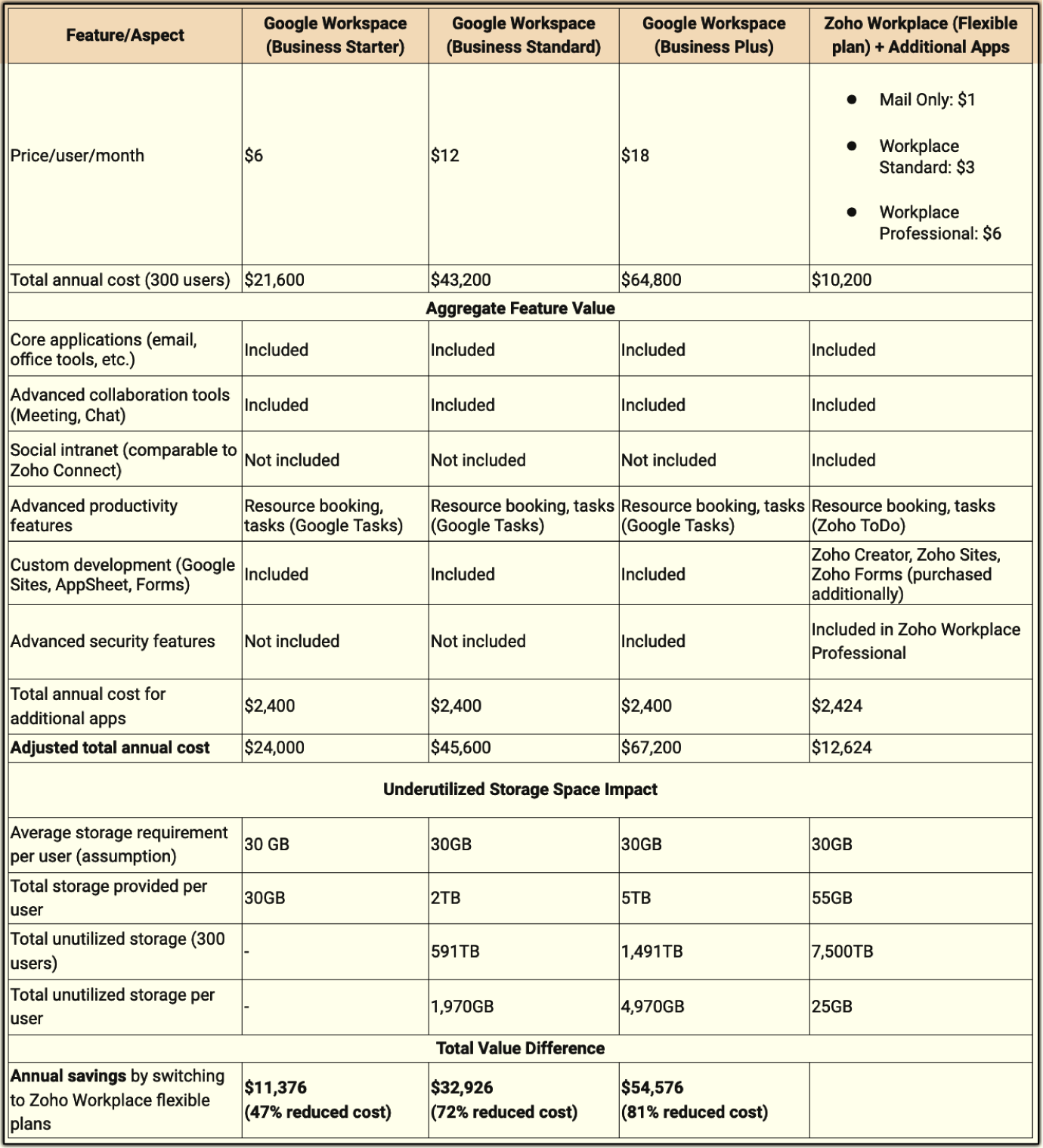
How much does Zoho Mail cost vs Gmail in India?
Zoho Mail Lite: Rs.59/user/month (annual billing). Google Workspace Business Starter: Rs.270/user/month. For 25 users, Zoho Mail saves Rs.63,300 per year. For 100 users, the saving exceeds Rs.2.5 lakh annually. Zoho bills in INR with no currency risk; Google bills in USD.