



Zoho One vs standalone apps: it’s the dilemma every growing business faces. Do you buy the entire “Operating System for Business” in one go, or do you cherry-pick individual applications as you need them?
As a certified Zoho Partner, we have guided multiples of companies through this exact decision. In 2026, the digital landscape is shifting toward unified data and AI-driven automation. Making the wrong choice now could cost you thousands in lost productivity and subscription fees later.
If you are looking for the definitive answer to Zoho One vs standalone apps which is better, you are in the right place. This guide covers the pricing, the apps list, and the hidden details that most salespeople won’t tell you.
Table of Contents
The Core Difference: Bundle vs. Best-of-Breed
To understand Zoho One vs standalone apps, you must first understand the architecture.
Standalone Apps (like buying just Zoho CRM or Zoho Books) are designed for businesses that have a specific, isolated pain point. You pay a higher premium per user for that single tool, but you often get the “Ultimate” edition features by default.
Zoho One, on the other hand, is an all-in-one suite. It is often called the “Operating System for Business.” It gives you roughly the Enterprise-level features of 45+ applications for a single price.
Expert Insight: In 2026, data silos are the enemy of growth. While standalone apps fix immediate problems, they often create long-term data fragmentation. Zoho One is built to unify that data from day one.
Cost Analysis: Zoho One vs Standalone Applications Details
Let’s get into the numbers. This is usually where the debate of Zoho One vs standalone apps which is better is settled.
The Standalone Cost Trap
If you purchase Zoho One vs standalone applications individually, the costs stack up fast.
- Zoho CRM (Enterprise) price : 👉 Click here
- Zoho Books (Professional): 👉 Click here
- Zoho Desk (Standard): 👉 Click here
- Zoho Projects (Premium): 👉 Click here
The Zoho One Advantage
Zoho One typically costs around $37-$45 per employee/month (depending on your country and payment plan).
For less than the price of the CRM alone, you get the CRM plus 40+ other apps. If your business uses more than two Zoho applications, Zoho One vs standalone apps details clearly show that Zoho One is the math-favored winner.
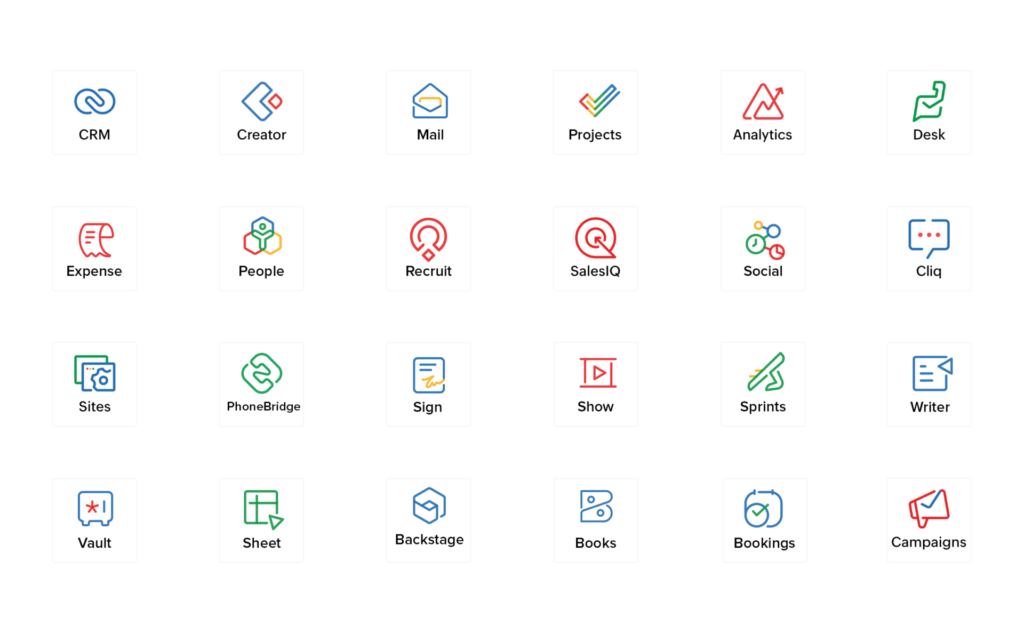
The “Zoho One vs Standalone Apps List” Breakdown
Many users search for a Zoho One vs standalone apps list to see what they are actually getting.
When you choose standalone, you get exactly what is on the tin. When you choose Zoho One, you unlock a massive library. Here is a quick comparison of what is included:
| Feature Category | Standalone Purchase | Included in Zoho One? |
| Sales | Zoho CRM, Bigin | Yes (Enterprise Grade) |
| Finance | Zoho Books, Invoice, Expense | Yes |
| Support | Zoho Desk, Assist | Yes |
| HR | Zoho People, Recruit | Yes |
| Marketing | Social, Campaigns, Survey | Yes |
| Productivity | Writer, Sheet, Show | Yes |
| Custom Apps | Zoho Creator | Yes (With limits) |
If you are looking for a Zoho One vs standalone app download, remember that Zoho One has a unified mobile launcher, but you can still download the individual mobile apps (like the CRM app or Books app) and log in with your Zoho One credentials.
Integration: The Hidden Nightmare of Standalone
When discussing Zoho One vs standalone applications details, we cannot ignore integration.
In a standalone setup, you might buy Zoho CRM today and a third-party accounting tool tomorrow. Connecting them requires API bridges, Zapier subscriptions, or expensive custom coding.
With Zoho One, the “Operating System” concept means these apps talk to each other natively.
- Example: A quote accepted in Zoho CRM automatically creates an invoice in Zoho Books and updates the inventory in Zoho Inventory.
Zoho One vs standalone apps isn’t just about price; it’s about the cost of your time managing integrations.
Scalability: Why 2026 Demands Unified Data
By 2026, AI will not be optional; it will be essential. Zoho’s AI assistant, Zia, works best when it has access to all your data.
If you choose standalone apps, Zia can only help you within that silo. If you choose Zoho One, Zia can analyze data from your Support Desk, your CRM, and your Financials to give you holistic business insights.
For businesses aiming for high growth, the Zoho One vs standalone applications list of benefits leans heavily toward One because it creates a “Golden Record” of your customer across all touchpoints.
When Should You Choose Standalone Apps?
Is Zoho One always the winner in the Zoho One vs standalone apps battle? No. Here are specific scenarios where Standalone is better:
- You are a Solopreneur with Niche Needs: If you strictly need only Zoho Projects and nothing else, $5 is cheaper than $37.
- You Need the “Ultimate” Edition Specifics: Occasionally, the version of an app included in Zoho One is the “Enterprise” version, but the standalone app has an even higher tier (like “Ultimate”) with increased API limits or storage.
- You Have a Large Non-Digital Workforce: Zoho One’s “All Employee Pricing” requires you to buy a license for every employee. If you run a factory with 500 workers who don’t use computers, the standalone model (buying licenses only for the 10 office staff) is cheaper.
Conclusion: The Verdict for Your Business
So, Zoho One vs standalone apps which is better for you?
- Choose Standalone if you have a very specific, narrow need and a strict budget under $30/month, or if you have a massive workforce that does not require software access.
- Choose Zoho One if you are a growth-focused business that wants to automate operations, eliminate data silos, and future-proof your tech stack for 2026.
Zoho One vs standalone apps is ultimately a choice between short-term savings and long-term value. As a Zoho Partner, we almost invariably see successful businesses migrate to Zoho One eventually.
Ready to Transform Your Business?
Stop guessing and start scaling. If you are still unsure about the Zoho One vs standalone applications debate, reach out to us today and let us help you map out your digital future.
Ready to Get Started on Zoho?
Let’s build your business the smart way — with Zoho and Codroid Labs by your side.
📅 Book your free consultation now
Q1: What is the main difference between Zoho One vs standalone apps?
The main difference is the architecture and cost model. Zoho One is an all-inclusive, unified operating system that provides access to 45+ applications (mostly at the Enterprise level) for a single, low price per employee. Standalone apps are purchased individually, often at a higher per-user cost, and require manual or third-party integrations (like Zapier) to share data, creating potential data silos.
Q2: Is Zoho One always cheaper than buying standalone applications?
In the vast majority of cases for growing businesses, yes. If your business utilizes more than two or three Zoho applications (e.g., CRM, Books, and Desk), the combined cost of the standalone subscriptions quickly exceeds the single, comprehensive price of Zoho One. The only exceptions are very small solopreneurs using one niche app or companies with a large non-digital workforce.
Q3: Which specific Zoho apps are included in the Zoho One suite?
Zoho One includes a comprehensive list of applications across every major business function. Key apps include Zoho CRM, Zoho Books, Zoho Desk, Zoho People, Zoho Projects, Zoho Campaigns, Zoho Social, and Zoho Creator, among many others. The suite is designed to give you enterprise-level access to the full Zoho One vs standalone apps list of tools needed to run an entire organization.
Q4: Do I get the full features of standalone apps when I use Zoho One?
Generally, yes. Zoho One grants access to the Enterprise or Professional edition features for most applications. In rare cases, a standalone application might offer an even higher “Ultimate” tier with specific features like massive API call limits or specialized storage, which might not be included in the Zoho One offering. For 99% of businesses, the Zoho One feature set is more than sufficient.
Q5: How does choosing Zoho One vs standalone applications impact my data and AI strategy in 2026?
Choosing Zoho One is critical for a strong data and AI strategy. Zoho One’s unified platform ensures all data (sales, finance, support) is instantly connected. This unification is necessary for Zoho’s AI assistant, Zia, to provide accurate, holistic business intelligence and advanced automation, which is nearly impossible to achieve efficiently with fragmented, standalone applications.